


The Minister’s Foreword to Cycle Infrastructure Design says that ‘cycling must no longer be treated as marginal, or an afterthought’, but that is exactly how it is treated by North Yorkshire Council (NYC).
We experience this negative attitude in dealings with officers, who are always keen to stress that active travel improvements are ‘aspirational’ and that they do not commit themselves to any meaningful change.
It is clear from the council’s actions that motor vehicles are at the top of their de facto transport hierarchy. Every scheme is designed to move more motor vehicles along roads faster. Pedestrians and cyclists are crammed together in any left-over space.
This attitude must stem from the lead given by senior officers and the Council Executive.
If there were a strong political drive to prioritise active travel and allocate resources to it, that would eventually be reflected in officers’ attitudes and actions.
Both the Corporate Director and the Executive Member for Transport say they support active travel – but that is not reflected by their actions.
2.1) Positives
York & North Yorkshire Combined Authority (YNYCA)
The new (May 2024) YNYCA and Mayor appear to have a much more positive attitude to active travel than NYC. We hope this will have an impact.
Previous Positives that have Turned to Disappointment
Karl Battersby was appointed Corporate Director of NYC in August 2020, and in an early meeting with him he said that as far as active travel was concerned we were pushing at an open door.
Five years later, there are no achievements to report.
At one time, Harrogate Station Gateway was listed here as a positive.

It was a £12 million Transforming Cities Fund (TCF) scheme intended to improve access by sustainable means to Harrogate town centre and the rail and bus stations.
Unfortunately, NYC stripped all the ambitious active travel elements out of the plans and turned it into a scheme for motor vehicles. The principal aspect of the current scheme is to make changes to the traffic lights on Station Parade so as to get more motor vehicles along there faster.
Prioritising cars is the exact opposite of the objectives of TCF funding, and no other council has misused the money in this way.
We were told in 2022 that two sustainable transport officers were being recruited, but nothing seems to have come of that. We were also told in Autumn 2024 that NYC was going to set up an Active Travel Team, but again that does not appear to have happened.
2.2) Negatives
2.2.1) Beech Grove
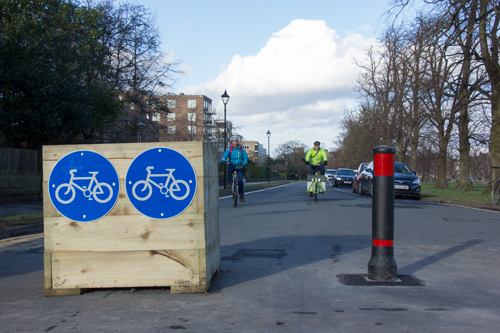
Modal filters were installed on Beech Grove in February 2021 for 18 months under an ETRO. This improved quality of life on the street, provided a safe crossing for people on foot, and created a high-quality cycle route into town.
It was proposed as part of the EATF, but not funded by the DfT. NYC funded it themselves on a trial basis, with the ETRO running until August 2022. It was the only reallocation of space to cycling in response to the pandemic in the whole of North Yorkshire. It was successful, and made a really significant difference. We hoped it would be made permanent.
At the last minute in August 2022, we were told that the ETRO had run its course and the modal filters were being removed. NYC said that this did not amount to a decision on the scheme, and no evidence report was prepared. Nevertheless, removing the modal filters is a decision.
These actions were in breach of NYC’s Network Management Duty to Support Active Travel, which stated that:
- local authorities had a duty to reallocate road space to active travel
- schemes must not be removed without proper evidence
- any decision to remove or modify schemes must be consulted on
- the assumption was that schemes would be retained unless there was substantial evidence to the contrary
NYC said that there would be another consultation on Beech Grove in Autumn 2022, which made no sense when we had already had a consultation from 18th February 2021 to 14th August 2021. In both consultations there was majority support for a scheme on Beech Grove.
NYC said they would start work on permanent measures for Beech Grove in September 2022, but inevitably that has proved to be an empty promise; nothing has happened.
2.2.2) Communication and Meetings
The Cycle Forum brought together HDCA, and the former North Yorkshire County Council and Harrogate Borough Council (HBC). It was chaired by HBC and involved meetings every quarter.
Councillors and officers rarely raised issues proactively, so HDCA set the agenda. Answers on specific issues were never given at meetings, but questions were taken away as action points. Most often they were still not dealt with before the next meeting.
The Cycle Forum meetings stopped when the local authority reorganisation happened and HBC was abolished. NYC talked about setting up a replacement forum, but they have done nothing about it.
More recently, we had regular Keep In Touch meetings with a senior NYC officer. These should have been positive, but it did not result in action on current projects. It was a pointless talking shop that was never going to achieve anything and we therefore withdrew from them.
Over the years the HDCA committee has been in regular contact with Area 6 highways officers to try to move active travel projects forward. Responses involve promises to talk to colleagues, assess situations, or commission reports. Action almost never results. Unless we diarise to chase matters up, we hear nothing further.
2.2.3) Delay
Delay is a chronic problem. Too often, officers do not appear to be motivated to achieve any results; their objective is simply to put off action to an unspecified future date.
Otley Road Cycleway was funded by the DfT in November 2017. Work was due to begin in 2018, but from then on the project was delayed by 3 to 4 months at a time, kicking the can down the road. After a while, we simply did not believe the new start dates announced, which included:
- August 2019
- October 2019
- March 2020
- April 2020
- July 2020
- August 2020
- December 2020
- January 2021
- July 2021
NYC divided the work up into phases, which is a part of their delaying tactics. Work on Phase 1 finally started in September 2021.
Phase 2 was due to follow on swiftly, but didn’t.
There was another consultation on Phase 2 in Autumn 2022, which showed majority support to proceed. Instead, NYC cancelled it, and diverted the remaining funds to other projects – enabling them to reset the clock and start a new period of delays.
This leaves Phase 1 of Otley Road Cycleway as an isolated segment. NYC now has a ‘some bits but not others’ strategy for Otley Road, which is useless for people who would like to cycle along it.
2.2.4) Crossings and Timing of Lights

NYC has a very negative attitude to active travel crossings of roads. They are 100% focused on moving motor vehicles.
Many crossings in Harrogate are uncontrolled, with just a refuge, so that those on foot have to scurry across the road when they see a gap in the traffic. The Prince of Wales roundabout is an example of this where people have to cross two lanes of traffic with no priority.
At light-controlled crossings, NYC typically make those on foot (and on bikes, where relevant) wait 40-50s. Officers describe it as ‘balancing the interests of different road users’, but it is plainly prioritising motor vehicles. It is hard to discuss a problem with people who cannot even describe it accurately.
At the standalone light-controlled crossing on Otley Road near the junction with Queens Road (pictured above), the lights very explicitly prioritise motor vehicles by detecting them with sensors, and staying green for them if they are present. The lights only go green for pedestrians when there are no cars – but then you can cross anyway.
On West Park and Parliament Street, there are five sets of lights. NYC have told us that they are set up and coordinated for the benefit of motor vehicles, to provide them with a ‘green wave’. Even though this is the town centre, and it includes a very important crossing point outside Bettys, no regard is paid to the needs of those on foot who want to cross.
TCF Harrogate Station Gateway is going to be used to create the same situation on Station Parade.
An excuse we have heard on several occasions when officers have refused to install a crossing is that drivers might not see it and be able to stop. One case was outside a school, where the school had commissioned a feasibility study for a new zebra crossing and was prepared to pay for the crossing itself. NYC refused on the basis that drivers might not see the crossing and might not stop. We believe that any drivers who are unable to see crossings should have their licences withdrawn.
2.2.5) Prioritising Motor Vehicles
In communications with NYC officers, they constantly refuse reasonable requests for active travel improvements because they explicitly prioritise motor vehicles.
We have told them on many occasions that those on foot and on bikes are ‘traffic’, and the highways authority therefore has a duty to ensure the expeditious and safe movement of pedestrians and cyclists as well as motor vehicles. NYC are not listening.
The design of Phase 1 of the Otley Road Cycleway is very poor largely because the designers have not been prepared to inconvenience motor vehicles in any way. Indeed, a major part of the design creates extra lanes for motor vehicles at the Harlow Moor Road junction, leaving pedestrians and cyclists crammed together behind railings in inadequate space.
2.2.6) Design Standards and Attitude to LTN 1/20
LTN 1/20 has had little effect in Harrogate & Knaresborough so far.
After its publication, NYC said that they were “aware of” LTN 1/20 and it “will be considered” in all new work. That is quite different from having read it, and applying it consistently.
The most common tactic is to make reference to LTN 1/20 in statements or documents, then put forward plans or designs which are in no way LTN 1/20-compliant. Equally, it is used as an excuse: ‘we would have liked to put in cycle infrastructure here, but as it would have to be to LTN 1/20 standards, it’s too expensive/there isn’t space’.
We would like NYC officers to apply LTN 1/20 in good faith, in an attempt to produce the best cycle infrastructure possible. Instead, too often they are looking for loopholes or opt-outs. If it says ‘where possible’, it will be impossible in North Yorkshire. If it says ‘preferably’, it won’t happen in Harrogate.
See more in 3) Cycle Infrastructure Design.
2.2.7) 20mph
NYCC produced a new 20mph policy which will ensure they can say no to every request. The killer paragraph is 5.13, which sets out a long list of criteria which will always give an excuse to refuse any request. The criteria include:
- the request aligns with NYCC policy on active travel
- the road is not Category 2
- low traffic flow
- a record of speed-related personal injury collisions over the last 3 years
- pedestrian and cyclist movements will be encouraged by 20mph
- suitable highway environment
- there is a school in the area
- existing average speeds below 24mph
- police enforcement will not be required
- vulnerable road user concerns outweigh longer journey times for motor vehicles
- improved quality of life for residents
- the scheme is unlikely to attract negative feedback
Nevertheless, after incidents where pupils walking to school were injured by drivers, there was a campaign by parents and head teachers for significant new 20mph zones in west and south Harrogate.
After delays and broken promises by officers, parts of the 20mph scheme – split into phases, of course – appear to be progressing.
2.2.8) Housing Development

New housing estates are going up all around the edges of Harrogate and Knaresborough. Most of them are rather far from the town centre for walking to be practical, but within a reasonable cycling distance. Unfortunately, none of them involve any useful cycle infrastructure.
NYC Development Control have failed to ensure that the developments include useful cycle infrastructure. Their attitude has been that they can’t or they won’t require any useful cycle provision.
S.106 money for active travel infrastructure is not collected (Killinghall), or turns out to be insufficient to build any useful cycle tracks (Pannal/Leeds Road), or is spent years later on inadequate facilities (Harlow Moor Road/Miller Homes).
There is a very big planned new development/expansion of the town, at West Harrogate. While there are some good active travel plans for the sites themselves, the wider transport strategy is entirely focused on motor vehicles.
Capacity increases for motor vehicles are planned at 30 junctions across a large area of south and west Harrogate, taking space that could otherwise be used for cycling facilities.
Meanwhile, NYC says it intends to build Phase 3 of Otley Road Cycleway to the lowest standards (shared use); and since the council cancelled Phase 2, there will be no connection to the town centre.
2.2.9) Lack of Presence in Harrogate
Part of the problem is that Area 6 highways officers are not based in the town of Harrogate, rarely visit, and don’t understand the transport issues here. The main offices are at Boroughbridge.
NYCC frequently makes statements about North Yorkshire’s large area, its vast road network, and its dispersed population in small market towns. That is true of much of North Yorkshire, but not of Harrogate and Knaresborough. They are densely-populated towns.
In Harrogate, most traffic is local people travelling short distances. There’s a lot of congestion and great potential for modal shift, but officers don’t grasp that.
2.2.10) Reluctance to Ride Bikes
This is another aspect of NYC committing to LTN 1/20 in theory but not in practice.
Summary Principle 20 states that all designers of cycle schemes must experience the roads as cyclists, and they should travel through the area on a bike to understand it.

On many occasions, we have asked officers to ride a route or an area with us. Every time, the answer has been no.
To their credit, two Transport Planners and one Area 6 officer did do an LCWIP-focused ride with us in Summer 2024.
2.2.11) Cycling Champions
NYC’s Cycling Champion role goes to the Executive Member for Transport.
Ideally, a Cycling Champion would regularly get around town by bike; they would understand the issues; and they would be an effective advocate and cycle campaigner. That can’t be guaranteed if the role just goes with the Executive Transport job.
Currently, Keane Duncan is NYC’s Cycling Champion. In our view, he is more hostile to cycling – and certainly hostile to us – than he is supportive of it.
Summary
The picture is bleak. As a brief summary:
- there is a major problem of a negative attitude to active travel embedded deep in the DNA of NYC
- whatever work is going on, active travel schemes are not being delivered
- NYC’s transport leaders say they support active travel, but we are yet to see any results
1) Introduction
Introduction and links to all other pages in this section.
2) Attitude of the Highways Authority
Notes on the attitude of the highways authority, NYC, and the way they approach active travel.
3) Cycle Infrastructure Design
The impact of LTN 1/20 Cycle Infrastructure Design in Harrogate, and the way it is applied (or not) by NYC officers.
4) Housing Development
The active travel disaster zone that is recent and ongoing housing development in Harrogate & Knaresborough.
5) Projects
A brief overview of some current projects in Harrogate & Knaresborough.
6) Junctions
This section highlights the issues which have not been addressed at some major junctions.
7) LCWIP
An analysis of the Harrogate & Knaresborough LCWIP, how/if it is being used in practice, and the work we are doing to try to improve it.
8) School Streets, 20mph and Modal Filters
Details of progress (if any) on School Streets, 20mph and modal filters.
9) Congestion Survey
The 2019 Congestion Survey and the mandate it gave NYC to pursue an active travel agenda. This section also includes a brief look at local decarbonisation strategies.
10) Solutions
Solutions to the problems with NYC’s active travel programme.