

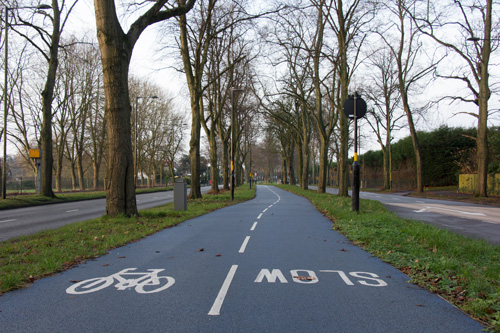
We hope that LTN 1/20 Cycle Infrastructure Design can have a transformative impact in Harrogate District, but that will only happen if it is applied, not ignored.
In October 2020 we produced a Summary of 24 Key Points for NYCC, and 3 Key Points for HBC.
Around this time, the then North Yorkshire County Council told us at a Cycle Forum meeting that they were aware of LTN 1/20, and that it would be considered in all new work. That is very different from having read it and being committed to applying it.
‘We are aware of LTN 1/20 and will consider it in all new work.’
NYCC in October 2020
Subsequently, the usual pattern of responses from NYC officers when asked to apply LTN 1/20 was to:
- cast doubt on whether LTN 1/20 applies in North Yorkshire
- question the authority of the document (‘it’s only guidance’)
- focus on a word or phrase in the relevant paragraph of LTN 1/20 (‘should’, ‘normally’, ‘preferably’, ‘try to’) and use that to claim that the provision is optional and can be ignored
- do whatever they wanted to do originally without reference to LTN 1/20
We raised this with Corporate Director Karl Battersby. He committed NYC to LTN 1/20 – but words are meaningless unless backed up with action. In practice, as soon as there are difficult choices to be made, LTN 1/20 is thrown overboard. Examples include:
- the design standards of Phase 1 of the Otley Road Cycleway
- NYC’s new 20mph policy
- West Harrogate urban expansion, where active travel is being sacrificed to allocating more space at junctions to motor vehicles
Another very disappointing feature of NYC’s approach, is the use of LTN 1/20 as an excuse for inaction or to make cycling provision worse:
- ‘we would have liked to build cycle infrastructure here, but because it would have to be to LTN 1/20 standards we don’t have the budget’
- ‘we would have like to build cycle infrastructure here, but because it would have to be to LTN 1/20 standards there isn’t enough space’
NYC refuse to provide early release for cyclists at the top of Lower Station Parade, as part of the Harrogate Station Gateway project. They cite para 10.6.44 of LTN 1/20, which says Advanced Stop Lines don’t meet the full accessibility needs of cyclists.
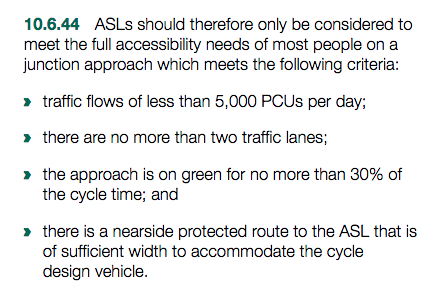
That paragraph is telling councils to do something better than ASLs, but NYC is using it as an excuse to make provision worse than it otherwise could be.
The fact that the council is prepared to wilfully misinterpret or misapply LTN 1/20 in this way corrodes trust in its integrity.
3.1) Positives
The items that were listed as positives here in 2020 have all become disappointments since then.
3.1.1) Harrogate Station Gateway
Harrogate Station Gateway was originally designed broadly in line with LTN 1/20.
We were very supportive of the original designs, but the NYC Executive failed to stand up to an application for judicial review and turned it into a scheme for motor vehicles – the exact opposite of the purpose of the Transforming Cities Fund money.
3.1.2) ATF2 Scheme on Victoria Road
The ATF T2 scheme on Victoria Avenue was also broadly LTN 1/20-compliant at the outset.
It was supposed to be completed by 31st March 2022, but Area 6 highways officers delayed and delayed and delayed, then stripped out all the cycling elements. What a disaster.
3.1.3) Officer Working on the LCWIP Zone Plans
The Transport Planner with whom we worked on our Harrogate Cycle Infrastructure Zone Plans had clearly taken the time to read and understand LTN 1/20, and in his work he applied it in good faith.
Unfortunately, the impact of the work in terms of on-the-ground improvements has been nil. It has been very largely ignored in the plans for the West Harrogate urban expansion. We agreed a list of Quick Wins with NYC, but the council then refused to progress any of them.
3.2) Negatives
3.2.1) Beech Grove
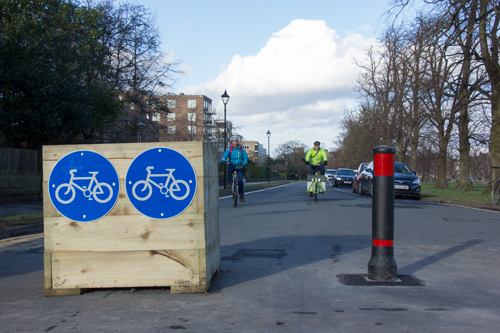
Beech Grove modal filters were put in under an ETRO in February 2021. This was the only LTN 1/20-compliant scheme in the whole of North Yorkshire.
In August 2022, it was taken out with no evidence report – in breach of LTN 1/20 and NYCC’s Network Management Duty to Support Active Travel.
NYCC’s conduct in this instance was appalling and irresponsible.
3.2.2) Otley Road Cycleway
There are constraints on Otley Road that mean the cycleway would always have involved compromises, but Phase 1 was not designed in line with LTN 1/20 so far as possible.

Cycles have not been treated as vehicles, since this route is largely shared use. The one change from previous NYCC shared use pavements is that there are cycle tracks across minor side roads.
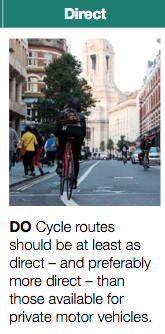
The cycleway is not Direct at major traffic-light controlled junctions like those with Arthur’s Avenue, Pannal Ash Road, and Harlow Moor Road – neither in distance nor in time. Cyclists are sent a short way up the junction side roads to wait with pedestrians at Toucans, while motor vehicles going straight on get a direct route and the lion’s share of green time.

Space for cycling should be created by reallocating carriageway space, not reducing the level of service for pedestrians. At the Harlow Moor Road junction, however, a large amount of extra space has been allocated to motor vehicles, leaving cyclists and pedestrians crammed together in shared use space that is far less than the minimum in LTN 1/20.
In effect, the Area team has treated the Otley Road/Harlow Moor Road changes as primarily a road capacity expansion project, with woeful quality shared use crossing facilities tacked on.

The minimum widths in the guidance have been consistently ignored on Otley Road. None of the dedicated stretches of cycle track reaches even the Absolute Minimum width.
NYCC’s stated excuse was that they designed Phase 1 of the Otley Road Cycleway a long time ago, so it doesn’t matter if it doesn’t meet LTN 1/20 standards. Our view is that a local authority should want to design and build the best cycle infrastructure possible, to modern standards.
This is backed up by Section 1 Question 8 of the Active Travel England self-assessment:

See our review of Phase 1 of Otley Road Cycleway.
3.2.3) J47 A1M
Around £10 million was spent on increasing capacity at J47 of the A1M. NYCC simply replicated the pre-existing narrow shared use path around the roundabout at the junction. The problems are:
- it’s far narrower than minimum widths in LTN 1/20
- it’s not connected to a network, so does not serve a cycling purpose
It is dispiriting to see that no thought whatever has gone into enabling active travel as part of this huge and expensive project. This could have been used as the opportunity to start creating a Harrogate-York cycle route.
The excuse for ignoring LTN 1/20 is ‘we designed this a long time ago’.
3.3) More Examples
There are many examples of North Yorkshire officers’ attitude to LTN 1/20, but here are two.
3.3.1) Paths in Housing Estates
Paths through housing estates should separate cyclists from pedestrians with levels or a kerb.
North Yorkshire development control officers jump on the word “try” in order to claim that this provision is meaningless and they do not have to follow it. This is not a good-faith interpretation of LTN 1/20.
At the Redrow development north of Kingsley Drive, they have refused to ask developers to separate cyclists and pedestrians with levels or a kerb.
This also applies to all new housing estates, where paths are shared use with no separation.

The other major issue with the path shown above is that it does not lead anywhere. It doesn’t even connect the vast new housing estate on the A59 Skipton Road to the nearest local shops at Oakbeck Park.
At the West Harrogate urban expansion:
- there are lots of warm words about active travel
- when it comes to the detail, the transport strategy is all about motor vehicles, and increasing capacity for them at 30 junctions in the area while entirely disregarding the needs of active travel
- cycle infrastructure within the developments may be to LTN 1/20 standards
- the developers and officers involved appear to be set on providing shared use pavements on Otley Road, while inaccurately claiming that there is not enough space for footways and dedicated cycle tracks. The Otley Road Cycleway will not reach the town centre
3.3.2) Cycling in Mixed Traffic and 20mph

Para. 7.1.1 of LTN 1/20 says that
- 2,500 vehicles per day and
- a speed of 20mph
are the desirable upper limits for cycling in mixed traffic.
North Yorkshire refuses to accept that ’20mph’ in the guidance means 20mph. According to officers, the use of the word ‘desirable’ indicates that “one size does not always fit all”. Therefore cycling in mixed traffic is appropriate at whatever speed North Yorkshire decides.
Again, this is not a good-faith interpretation of the guidance. It amounts to performing logical contortions in order to strip the guidance of any meaning so that North Yorkshire can disregard its provisions.
We would like officers to be straight with us. Claiming to apply LTN 1/20, while in reality ignoring its provisions, corrodes trust.
In reality, NYC’s 20mph policy is not consistent with LTN 1/20 and needs to be changed.
3.4) Summary
In summary, NYC are aware of LTN 1/20, and make reference to it in their statements and documents.
As soon as there are difficult choices to be made, LTN 1/20 is jettisoned. Unless NYC are forced to apply LTN 1/20, they will continue to prioritise motor vehicles, and as a result cycle infrastructure will be well below the minimum standards.