

North Yorkshire Council (NYC) has just published its Active Travel Capability Self-Assessment. It was written in December 2023, but has not been available until now.
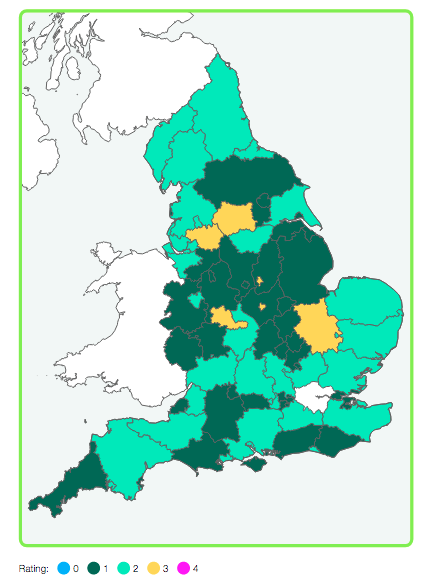
The council rated itself Level 2, but Active Travel England (ATE) kept NYC among the lowest-rated councils in England on Level 1.
Is NYC’s self-assessment fact-based, or is the council heroically over-optimistic when analysing its own performance? Here are six points about the self-assessment.
1) Unrealistic Assessment of Executive Leadership on Active Travel
NYC self-assessed as Level 2 on Leadership.
The Council’s Claims
In the Overall Capability Rating section (5), the council says of itself:
‘Level 2 – Strong local leadership, with clear plans that form the basis of an emerging network with a few elements already in place’.
In Section 2, Local Leadership, NYC says it ‘has members who are committed to increasing active travel in line with the government vision set out in Gear Change’.
It claims to have 5 to 8 policies in place that prioritise active travel. Such policies can include for example:
- commitment to quality (LTN 1/20)
- active travel delivery to reduce carbon emissions from transport
- area-wide traffic management schemes that reduce traffic on residential and high streets, e.g. school streets, pedestrianisation
- restrictions on pavement parking
- cargo or freight delivery using active travel modes
The Reality
The notes in the self-assessment say that Section 2 is aimed at understanding ‘the extent to which your leaders and elected members support active travel and your authority’s related transport and planning policies’.
The key people in this context are the Cabinet Member for Transport Keane Duncan and the Council Leader Carl Les.
In February 2023, Keane Duncan cancelled Phase 2 of Otley Road Cycleway, and ruled out reinstating the Beech Grove modal filters which he had taken out in August 2022.
Cllr Duncan was also in post when the council’s ATF4 bid failed.
He has not put forward any new active travel schemes since his appointment in May 2022, nor delivered any on-the-ground improvements. He has been hostile to us at the cycle campaign.
As a result, the Gateway project changed from a sustainable travel scheme that reallocated space away from motor vehicles, to one that is essentially focused on motor vehicles.
We invited Cllr Les to meet us on site to discuss Beech Grove and the lack of cycling infrastructure at new housing developments, but he did not even engage with the request.
In respect of policies prioritising active travel, NYC has very few.
It has not built any modern cycling infrastructure to LTN 1/20 standards, it removed its only Low Traffic Neighbourhood (Beech Grove), it allows pavement parking, it has no measurable targets to reduce greenhouse gas emissions from transport, and there are no cargo bike delivery schemes.
North Yorkshire is a high-carbon, high-traffic county, where motor vehicles are top of the de facto transport hierarchy.
2) Track Record of Delivery
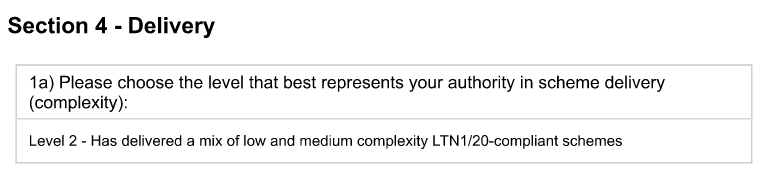
The council self-assessed at Level 2 for Delivery in the last three years.
The Council’s Claims
In Section 2, NYC says it has ‘a track record of completing low and medium complexity LTN 1/20/MfS-compliant active travel schemes’. Section 4 Delivery echoes this, claiming ‘a mix of low and medium complexity LTN 1/20-compliant schemes’.
In the related evidence sections, the council cites
- Phase 1 of Otley Road Cycleway as a medium-complexity scheme and
- Resurfacing the Cinder Track between Scarborough and Burniston as a low-complexity scheme
In relation to Otley Road the council says:
‘The route comprises 535m of traffic free provision both sides of the road…Cycle priority junctions and two new toucan facilities were also included in the scheme. The route provides a safe alternative to hostile road conditions’.
As for the Cinder Track:
‘Improvements to the LCWIP Cinder Track scheme at Scarborough (delivered between Scarborough and Burniston in 2022) sit within the low complexity category of new shared use given the route is off road and connects settlements, tackling severance in walking and cycling networks’.
The Cinder Track resurfacing was the only capital scheme delivered on time. NYC says:
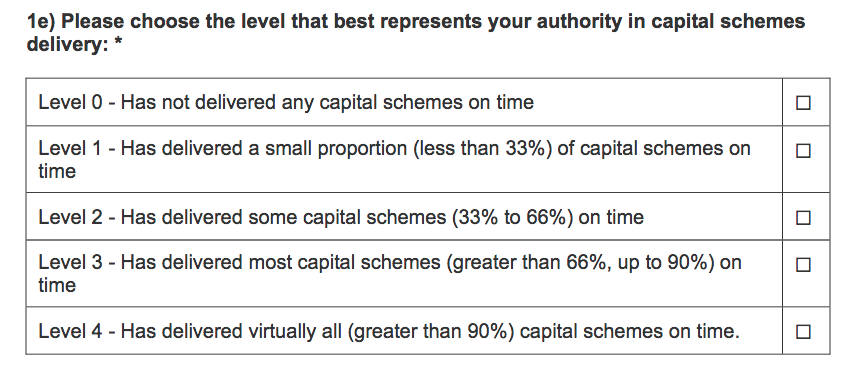
‘Given the above, within the last three years 16.6% of active travel capital schemes have been delivered on time’.
The Reality
North Yorkshire consistently fails to deliver on time.
These are some of the funded schemes which have failed to proceed on time or at all:
- Otley Road Cycleway – funded 2017: one isolated section built in 2021, the rest abandoned
- four ATF2 cycling schemes – funded 2020 with a construction deadline of 31st March 2022: three abandoned, the remaining one (Victoria Avenue) still in design phase and the cycling elements stripped out
- Harrogate Station Gateway – funded 2019: delayed, and most active travel elements stripped out; project now focused on motor vehicles
- Bilton Lane crossing – construction by March 2023; work still has not started
- Killinghall buildout – delayed, with no date set for work to start
- Oatlands Drive and Wetherby Road crossings – construction due to be completed by March 2024, but no work has started
Otley Road Phase 1 and the Cinder Track are not just examples of schemes delivered; they are the only ones.
Otley Road Phase 1 was not delivered to LTN 1/20 standards. For example:
- it uses white line segregation, not colour and level difference
- at junctions, space has been reallocated to motor vehicles leaving substandard width shared use areas for people on foot and on bikes
- NYC cancelled Phase 2, so that Phase 1 will remain isolated rather than forming part of a coherent network. This is a Core Design Principle in LTN 1/20
We produced a six page review of Phase 1.
The Cinder Track was not new shared use, it was just resurfacing and widening. Further, it was done by Scarborough Borough Council, and not by NYC at all.
If you remove Scarborough BC’s work, the proportion of schemes completed on time falls to 0%.
That puts the council firmly on Level 0 for delivery.
3) Active Travel Represents 0.79% of NYC’s Total Transport Budget
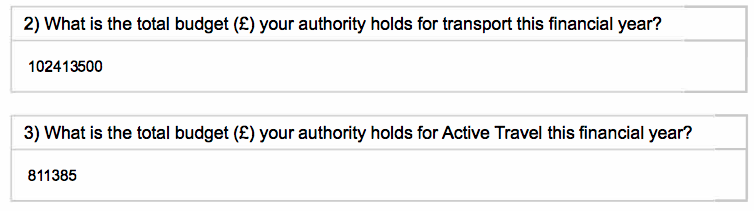
NYC say that the total budget they held for active travel was £811,385. The total transport budget was £102,413,500.
This makes active travel 0.79% of the total transport budget.
The notes to Section 2 of the assessment say that a high proportion of local transport funding allocated to active travel schemes is 15% or more.
4) Standards for Developers
The Council’s Claims
NYC claims that it requires developers to follow LTN 1/20. It admits that it has not added ATE’s planning application assessment toolkit to its validation checklist for planning applications.
The Reality
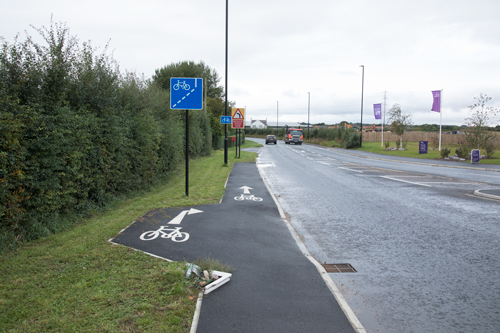
The reality is that none of the housing developments built in Harrogate & Knaresborough in recent years have any useful cycle infrastructure.
Most have substandard shared use facilities that give way to every side street within the developments themselves. None have cycle links to key destinations such as shops, schools, employment and transport hubs.
5) Active Travel Improvements when Maintaining or Resurfacing Roads
The Council’s Claim
The self-assessment asks councils if they have a process to ensure they consider updating road markings to be in line with TSRGD 2016 and LTN 1/20 when undertaking maintenance or highways resurfacing.
NYC’s answer is no, but in the evidence box it adds:
‘Although there is no formal process in place, NYC project engineers stay up to date with the latest standards through CPD so any maintenance/highway resurfacing schemes will be in line with TSRGD 2016 and LTN 1/20’.
The Reality
Road markings are re-painted like for like without any reference to LTN 1/20.
6) Network Planning
The Network Planning section of the self-assessment is more honest and realistic than the rest of the document.
NYC rates itself Level 1 for Network Planning.