

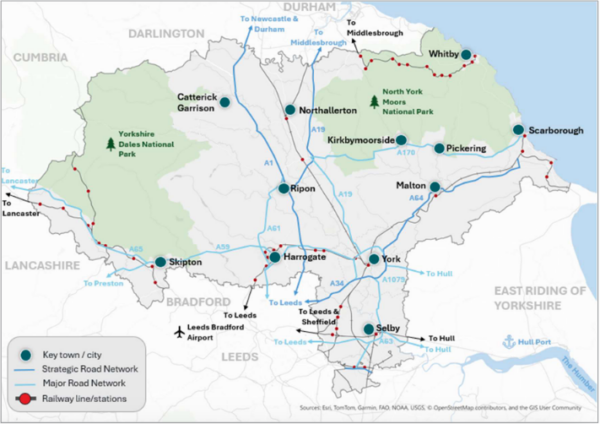
York & North Yorkshire Combined Authority (YNYCA) has published a draft Local Transport Plan (LTP) which will be considered at a meeting on Friday 5th June 2026.
There is a lot that is very good in the document. These are some of the highlights.
Highlights (TL;DR)
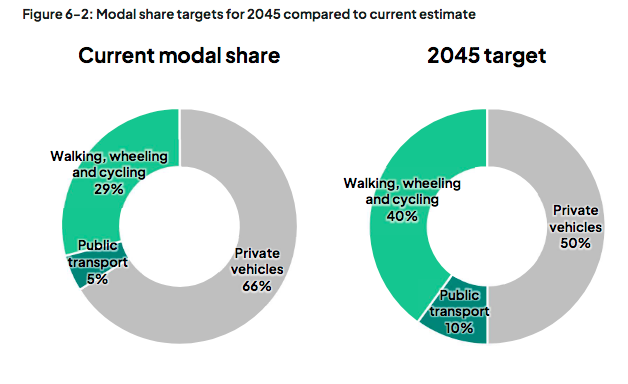
- the target for active travel is to increase mode share from 29% to 40% by 2045; this includes 65% of trips under 3 miles
- the LTP is very clear that it wants to reduce car dependency and increase walking, wheeling and cycling. For example, walking, wheeling and cycling should be prioritised over private vehicles in ‘liveable neighbourhoods’
- the region will adopt Healthy Streets principles
- YNYCA will invest in delivering coherent, safe and high-quality walking, wheeling and cycling networks in towns and cities. Town and city centres are to be reshaped to prioritise people over traffic
- an integrated transport strategy means enabling walking, wheeling and cycling to public transport hubs
- the CA intends to use powers to enforce against pavement parking
- the LTP commits the region to working towards Vision Zero
- the solution to congestion is not expanding capacity for motor vehicles but enabling alternative modes. Travel demand management will be considered
- an Avoid-Shift-Improve approach will be taken to decarbonising transport
- there are to be more green spaces in urban areas
- side road zebra crossings are to be used
- Quiet Lanes will be considered in rural areas
- there is to be a regional Walking Wheeling and Cycling Strategy, which will identify a Strategic Cycle Network
- there is no traffic reduction target, but the LTP says population growth should not be accompanied by significant traffic growth
- on-street car parking could be repurposed (e.g. cycle parking or tree planting)
- speed limits are to be reviewed in line with DfT guidance
- there is a road user hierarchy to support consideration of the needs of those using sustainable modes
- progress will be measured through various formal mechanisms
Eight Sections of the LTP
The LTP is split into eight sections.
- Introduction
- Unlocking York & North Yorkshire’s Potential
- Our Vision for a Connected City Region Rural Powerhouse
- Connected Places
- Network Principles
- Integrated Modes
- Measures for Success
- Delivering the Strategy
1) Introduction
The Introduction says (para 1.1) that the Mayoral Investment Fund is worth £540 million (£18 million per year for 30 years).
In addition, the Mayor has control over the Mayoral Transport Fund, worth £100 million per year (1.2).
Under the devolution order the Mayor has exclusive powers in transport planning, and produces a single LTP for the region.
2) Unlocking York & North Yorkshire’s Potential
Some of the context set out in this section includes:
- there are 840,000 residents in the region (2.1)
- this is an opportunity to show what integrated transport can achieve beyond the major metropolitan areas (2.2)
- the LTP is an attempt to improve access to opportunity while cutting emissions and supporting healthier lives (2.4)
- North Yorkshire has 32 million visitors per year and 38,000 jobs in tourism; the equivalent figures for York are 9.4 million visitors and 16,800 jobs (2.7)
- there are to be 60,000 new homes in the region over the next 10 years; this must be planned around sustainable connectivity, otherwise there is a risk of deepening car dependency and congestion (2.9)
- transport accounts for 32% of the region’s GHG emissions (2.13)
- to reduce emissions, we need to reduce the need to travel and change the way we travel including more walking, wheeling and cycling and public transport (2.14)
- one of the aims of the LTP is better integration of public transport and walking, wheeling and cycling (2.19)
The purpose of the LTP is (2.21):
‘…not simply to describe the network we have, but to set the direction for the network we need: one that supports growth with purpose, reduces inequality, improves health, accelerates decarbonisation and strengthens the long-term resilience and competitiveness of the region’.
The Mayor’s key priorities are (2.24):
- sustainable growth – new development to embed sustainable travel behaviours
- connecting all parts of our diverse region – including more comprehensive walking, wheeling and cycling networks
- resilient and future-proofed transport networks
- cleaner and greener transport
- nationwide connectivity – to neighbouring areas and wider UK destinations
3) Our Vision for a Connected City Region Rural Powerhouse
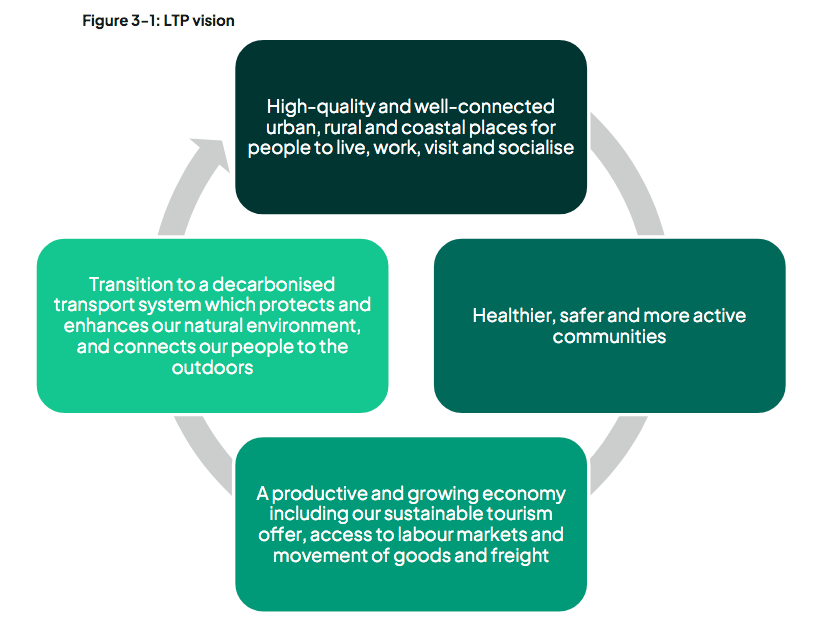
Section 3 contains the LTP’s vision, with four elements:
- High-quality and well-connected urban, rural and coastal places
- Healthier, safer and more active communities
- A productive and growing economy, including sustainable tourism
- Transition to a decarbonised transport system which protects and enhances our natural environment
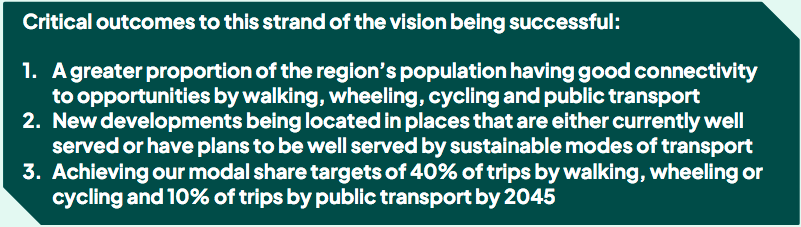
Critical outcomes of the first element include that new developments should be located in places well-served by sustainable transport; and achieving mode shares of:
- 40% of trips by walking, wheeling and cycling by 2045 and
- 10% of trips by public transport by the same date
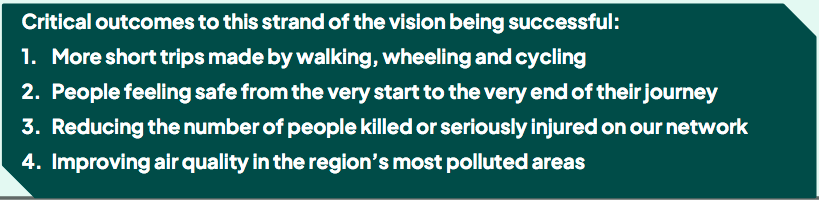
The text under the second strand of the vision says that ‘we need to reduce dependence on cars and make walking, wheeling and cycling the easiest and most attractive choices for everyday journeys and leisure’.
It points out that 13% of York residents are classed as inactive, and 24% of those in North Yorkshire.
These are the critical outcomes.
Under the third element of the vision, a growing economy, one of the critical outcomes is more people accessing our tourist attractions by sustainable modes.
Under the fourth element, the LTP notes that the National Parks have some of the highest transport emissions.
The LTP seeks to reduce transport emissions in line with the region’s Strategy for a Sustainable Future.
4) Connected Places
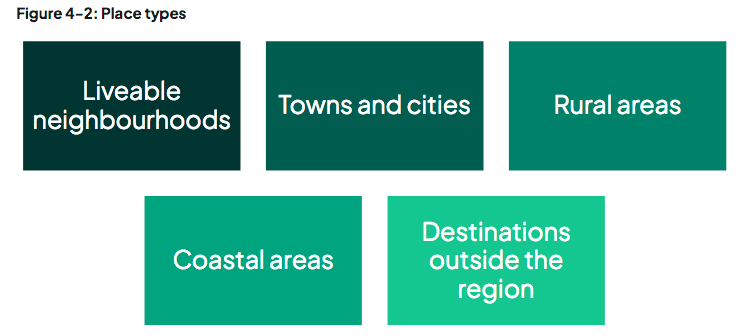
The LTP identifies five place types:
- Liveable neighbourhoods
- Towns and cities
- Rural areas
- Coastal areas
- Destinations outside the region
Liveable Neighbourhoods
Liveable neighbourhoods should be people-focused places (4.8).
This is to be achieved by (4.9):
- making streets safer
- prioritising walking, wheeling and cycling over private vehicles
- improving local access to bus stops and rail stations
- access to local shops and schools by walking, wheeling cycling and public transport
- creating greener and more attractive environments
One commitment is to install secure public cycle parking in more residential areas.
The region will adopt Healthy Streets principles – measures including School Streets, play streets and Low-Traffic Neighbourhoods.
Walking, wheeling and cycling to school is a priority.
Towns and Cities
‘We want our towns and cities to be seen as some of the safest, cleanest, healthiest and most vibrant in Europe’.
The LTP says (4.14) ‘we need to find more efficient ways for people to be able to move into, out of and around our towns and cities. As our towns and cities are likely to be locations of significant growth, this will enable our larger settlements to grow sustainably without significantly increasing traffic levels’.
The LTP’s commitment is:
‘We will invest in delivering coherent, safe and high-quality walking, wheeling and cycling networks in our towns and cities’.
It adds (4.16) that one objective is:
‘Reshaping our town and city centre streets to prioritise people over traffic, creating places people want to spend time in’.
5) Network Principles
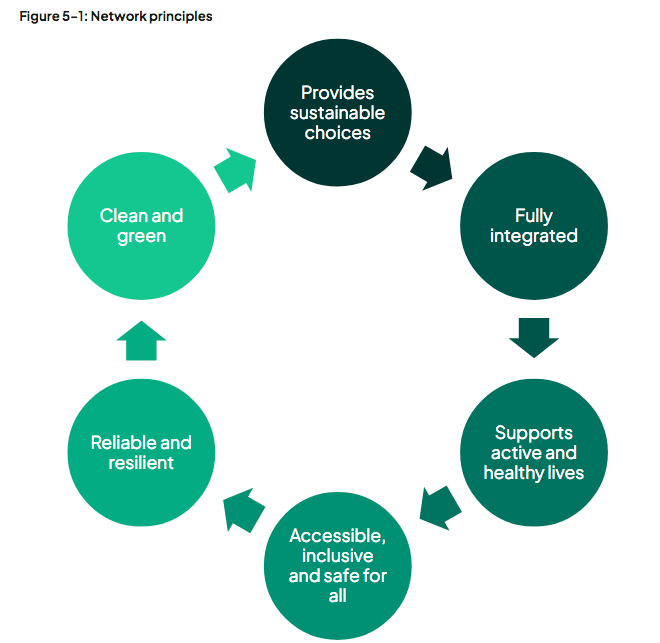
Figure 5-1 outlines the principles used to plan, design and operate transport networks in the region.
Provides Sustainable Transport Choices
The principles here include:
- provide services closer to where people live (5.4)
- improve sustainable alternatives to the car (5.4)
‘We will improve local service provision and transport connectivity across our region to ensure that more people can access key services by walking, wheeling, cycling and public transport’.
- new houses and jobs in locations already served by sustainable modes (e.g. close to rail stations and bus services (5.6)
- development sites where people have good access to day-to-day services by walking, wheeling and cycling (5.7)
‘We will ensure that transport issues are considered at the earliest planning stage for new housing and commercial developments, with a priority to ensure new developments are well-connected and accessible for all and travelling sustainably is the natural first choice’.
Fully Integrated
Under this sub-heading, the LTP says that one the Combined Authority’s aims is:
‘Developing high-quality walking, wheeling and cycling networks to allow people to access the places they need to go (including walking, wheeling or cycling to their local bus stop or rail station)’
Supports Active and Healthy Lives
YNYCA wants to support active and healthy lives through investment in transport (5.16).
There will be a Walking, Wheeling and Cycling Strategy for the region (5.19).
‘We will also set out specific plans for improving walking, wheeling and cycling in local neighbourhoods and in our towns and cities to help tackle congestion, create cleaner, greener streets and encourage more footfall in our local centres and high streets. This includes adopting a Healthy Streets approach to creating outdoor spaces’. (5.20)
‘As well as providing high-quality, segregated and fully accessible walking, wheeling and cycling infrastructure, this may require measures to reduce the volume or speed of traffic on certain streets to make them more conducive to walking wheeling or cycling.
We will prioritise space for people in residential areas to enable more people to live healthy and active lives in their communities’. (5.21)
Accessible, Inclusive and Safe for All
Accessibility includes barrier removal on walking, wheeling and cycling infrastructure (5.24).
In relation to pavement parking, the LTP says (5.27)
‘The English Devolution and Community Empowerment Act 2026 grants powers to local transport authorities to crack down on illegal pavement parking, which we will use to improve the accessibility of our footways for all users and particularly for some of the most vulnerable members of our society’.
Para 5.32 notes that rural roads are some of the most dangerous in the country, especially for motorcyclists.
The LTP commits to working with the YNY Road Safety Partnership towards Vision Zero.
Reliable and Resilient
This is largely about road maintenance and congestion.
The LTP has a good passage on congestion (5.36):
‘A key aspect of a more resilient network is providing better travel choices for everyone, and encouraging more drivers to use alternative modes of transport will help to reduce the number of vehicles on our roads’.
It adds:
‘Where necessary, we will also consider the implementation of travel demand management measures to reduce congestion through behaviour change’.
Para 5.41 talks about ‘signal upgrades to improve the movement of people or priority routes for certain modes of transport’. At least it isn’t just tweaking traffic lights to move more cars, a top priority for North Yorkshire Council.
Clean and Green
‘Our ambition is for a low-emission transport network that supports our commitment to achieving carbon negative status by 2040 and promotes greater biodiversity where possible’.
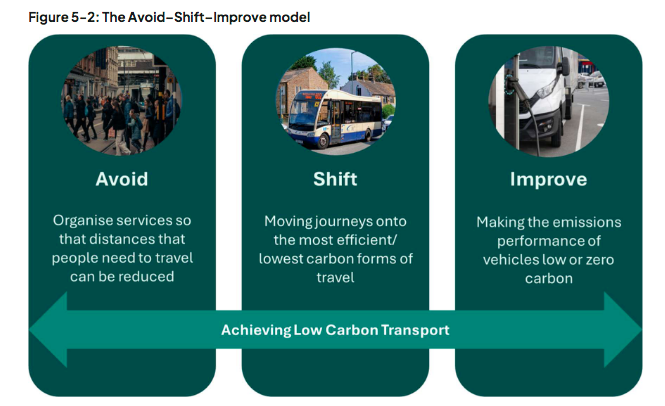
The LTP says that embodied carbon in new transport infrastructure will be minimised, and to avoid the negative environmental effects of a car-based transport system the model will be Avoid-Shift-Improve.
The LTP wants more public EV charging, but without creating accessibility barriers on footways (5.50).
It notes drawbacks of EVs: particulate matter from tyre and brake wear, and cheaper motoring encouraging people to drive more and create more congestion (5.52).
The LTP envisages more green spaces in our urban areas, for example through tree-planting on streets.
6) Integrated Modes
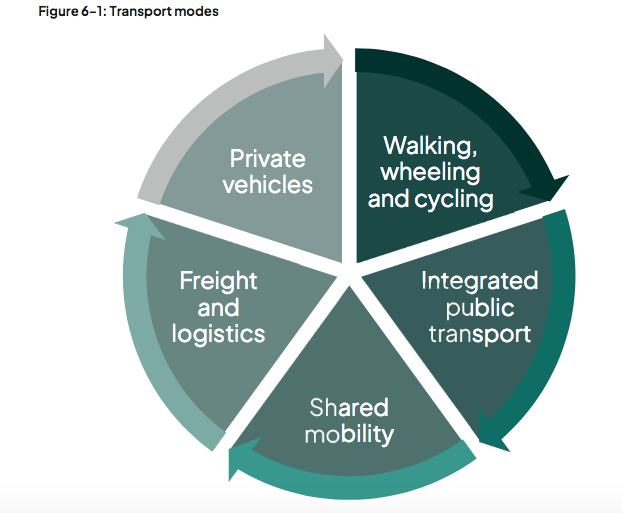
Modes are grouped into five categories, as shown in the image above.
There are targets for modal shift:
- walking wheeling and cycling to increase from 29% to 40% by 2045 and
- public transport to increase from 5% to 10% by 2045
The LTP deals with each of the modes in turn.
Walking, Wheeling and Cycling
‘Our ambition is for walking, wheeling and cycling to be an easy, safe and attractive way for people in York and North Yorkshire to undertake everyday short journeys. To support our headline modal share targets outlined above, want to see 65% of all journeys under 3 miles made by walking, wheeling or cycling across the region’. (6.6)
We need to expand and better connect our walking, wheeling and cycling networks (6.7).
‘We will prioritise walking, wheeling and cycling infrastructure as the primary mode for short trips’.
Para 6.8 says that in urban areas ‘we need to fill short gaps in local walking, wheeling and cycling networks’.
‘We need to provide adequate walking, wheeling and cycling routes to bus stops and railway stations to ensure that more people can access our public transport network sustainably’. (6.9)
Excitingly, this includes the installation of side road zebra crossings to reinforce priority for those walking and wheeling.
‘We will identify and fill local gaps in walking, wheeling and cycling networks to enable people to undertake day-to-day activities more easily without the need for a car’.
Wayfinding needs to be improved (6.10).
In rural areas, Quiet Lanes could be introduced (6.11). The network of footpaths and bridleways is to be protected and enhanced.
Work to improve walking and cycling networks will build on existing LCWIPs, ‘ensuring that routes are accessible, safe, continuous, convenient and part of a coherent network’ (6.14).
YNYCA will produce a Walking, Wheeling and Cycling Strategy for the region, including a Strategic Cycle Network for York & N Yorkshire (building on the National Cycle Network).
Integrated Public Transport
The strategy includes public transport hubs better connected by safer walking, wheeling and cycling routes (6.19).
The LTP mentions the Mini Switzerland pilot in the Peak District, with integrated timetables and ticketing across multiple routes and modes (6.20).
Shared Mobility
Shared mobility includes e-bike and e-scooter hire schemes. The commitment here is to (6.32):
- reintroduce a scheme in York and
- consider the rollout of similar schemes in Harrogate and Scarborough
Private Vehicles
‘Our ambition is to ensure that journeys that need to be undertaken by private vehicle are as reliable as possible, whilst minimising negative impacts on our people and places’.
Para 6.41 lists some of the negative impacts, which include congestion, speeding, noise and air pollution, people killed and seriously injured, and the significant amount of space taken up by car parking in our neighbourhoods and local centres.
‘As the regions grows, we need to ensure that population growth is not accompanied by significant traffic growth which will exacerbate the negative impacts of traffic on everyone’s lives.
Unconstrained car growth will not make the most efficient use of our limited road capacity, so we need to design our places around the needs of people, not traffic, and we need to think about where and how we invite private vehicles into our local neighbourhoods, towns and cities’. (6.42)
Policies to manage the negative impacts of cars include (6.43):
- planning new developments to minimise the need for a car
- repurposing on-street car parking for other uses such as cycle parking, tree planting etc
- speed limit enforcement and tackling pavement parking
- review speed limits in line with DfT guidance
The LTP identifies four categories of road:
- Strategic Road Network – managed by National Highways
- Major Road Network – key links between Strategic Road Network and the rest of the network
- Key Route Network – strategic connections across the region
- Local Road Network – connects to local destinations including residential areas
A road user hierarchy shows the order in which users’ needs are considered.
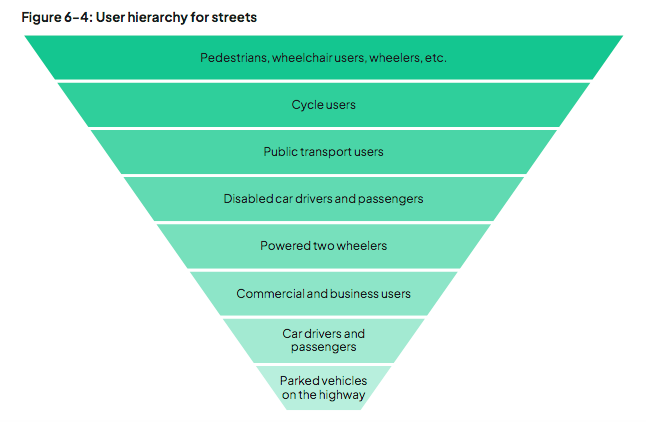
‘For example, on local residential streets, we will want to give much more priority and focus to the needs of those who are walking, wheeling and cycling, which may mean limiting where we allow cars and other motorised vehicles’. (6.50).
The Combined Authority may develop a movement and place plan for the region (6.52).
The LTP says a Healthy Streets framework will be adopted (6.53).
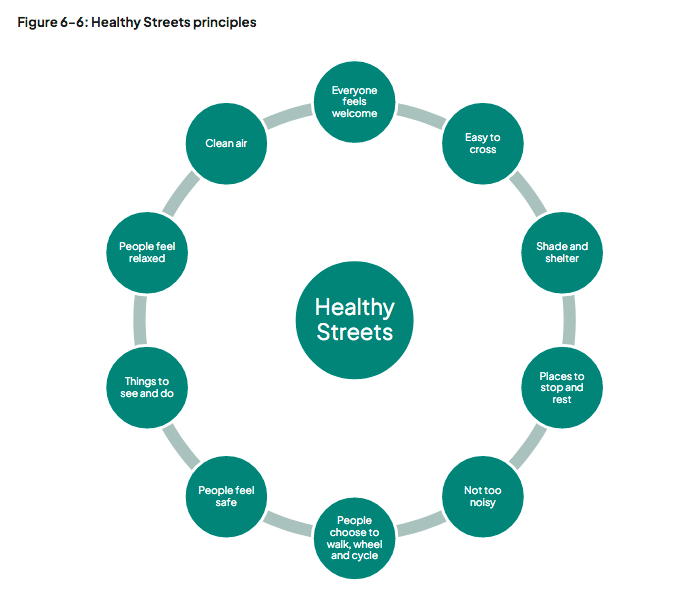
‘A key element of delivering the Healthy Streets principles will be managing parking to ensure that street space is prioritised for people to walk, wheel or cycle or amenities such as parklets.
We also need to ensure that parking is not so abundant and inexpensive that it encourages people to use private vehicles unnecessarily over more sustainable modes’ (6.54 & 6.55)
Robust car parking management strategies will be introduced to incentivise the use of sustainable modes.
7) Measures for Success
The main ways of measuring progress will be:
- Key Performance Indicators
- a Monitoring and Evaluation Plan and
- the DfT’s Local Transport Outcome Framework which scores authorities against national priorities
The KPIs are:
- Access to everyday services
- Public transport reliability
- Journeys by mode
- Transport-related carbon emissions
- KSIs
- Transport-related social exclusion
- Active travel delivery (including AT Capability Rating)
- Road maintenance delivery
8) Delivering the Strategy
There will be a scheme pipeline (8.1).
YNYCA is still in the process of developing its transport assurance framework (8.3). Para 8.5 describes the reports the CA will produce.