

York & North Yorkshire Combined Authority (YNYCA) is consulting on its draft Strategy for a Sustainable Future (‘the Strategy’).
It supersedes the 2022 Routemap to Carbon Negative, which was a genuinely ambitious document. On transport, the Strategy is significantly diluted, and lacking measurable targets.
Consultation
The consultation on the Strategy runs from 15th April to 10th June 2026.
The Strategy
The Strategy is full of lofty goals, with words such as ‘trailblazing’, and the stated intention to ‘put York & North Yorkshire at the forefront of national climate action’.
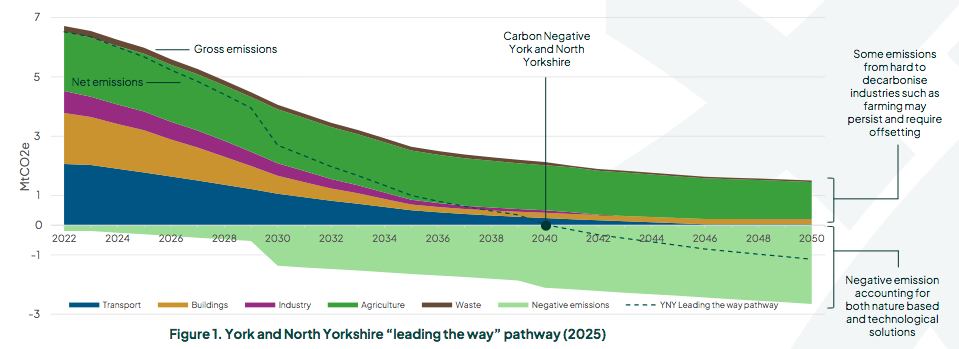
One objective is for York & North Yorkshire to be the first carbon negative region, by 2040.
This means:
- reducing emissions by 90% by 2040 compared with a 2022 baseline
- removing more than the amount of the residual emissions
- adapting to the climate change that is already baked in
The Strategy says that sustainable choices need to be made easy, convenient and affordable, and public confidence built that tackling climate change is feasible.
There should be a shift in mindset from reducing harm to doing good.
There is a Carbon Reduction Pathway.
Strategic Pillars
The Strategy identifies these Strategic Pillars:
- securing energy independence – there are to be Local Area Energy Plans
- circular economy – moving from take-make-dispose to a circular economy with repairable products
- enhancing the environment – this includes regenerative agriculture, crop rotation and agroforestry
High-Impact Sectors
The High-Impact Sectors are identified as:
- power – renewable generation and inclusive ownership models are among the solutions
- home heating – retrofit and sustainable heating needed
- transport – easy, safe and affordable walking, wheeling and cycling routes and public transport required
- business – clean, locally-owned energy, and cleaner logistics and business travel
- farming – restore peat, plant trees, and use regenerative and precision agriculture; better water quality
- marine and coastal environments – carbon capture, nature recovery and coastal defences
- community action
Strategic Enablers
Under the heading Strategic Enablers, the Strategy talks about creating the right conditions to make it easy, convenient, affordable and desirable for people and businesses to make sustainable choices.
This can happen through:
- ambitious strategies
- ensure sustainable choices align with people’s values and priorities
- funding and investment
- establishing infrastructure including active travel routes
Big Goals
The Strategy’s Big Goals are classified under these headings:
- healthy and thriving communities
- economic transformation
- becoming England’s first carbon negative region
Diluted Ambition on Transport
The Routemap to Carbon Negative had clear measurable goals on walking, cycling and reduction on vehicle miles travelled.
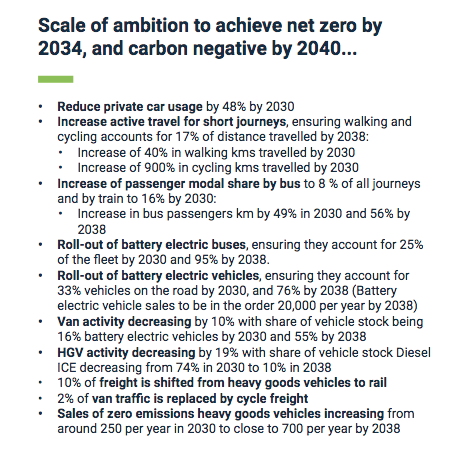
By contrast, the Strategy has:
- no specific, measurable target for cycling
- no target for reducing vehicle miles travelled
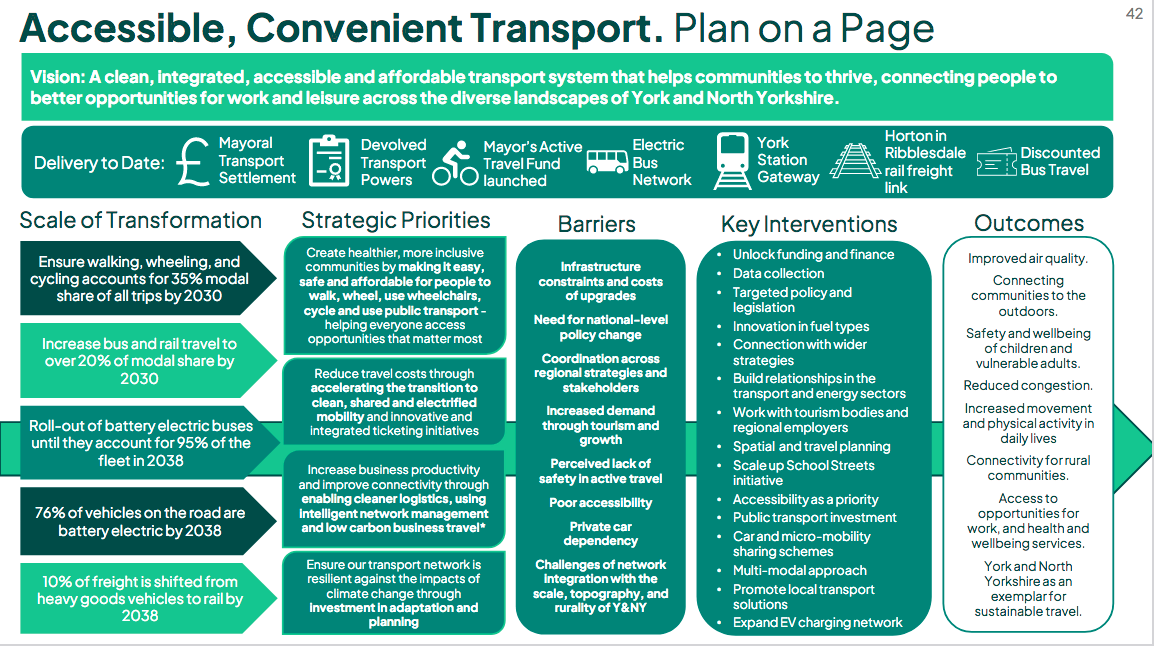
What is the current modal share of walking, wheeling and cycling? It is not stated in the Strategy. How much more walking, wheeling and cycling is needed to reach 35% by 2030? We don’t know, so the Combined Authority and the councils can’t be held to account.
The Strategy says that transport is the biggest emitting sector, at 32% of the total.
Although emissions have come down since 2005, they have gone up from 2020 to 2022 (1.70 to 1.77 MtCO2e).
The Strategy’s Strategic Transport Priorities include:
‘Develop the infrastructure to rapidly improve active travel provision, increasing safety, accessibility and connectivity, to enable the choice to frequently use walking, wheeling, wheelchair use and cycling for short journeys (<2km for walking and 8km for cycling)’.
The Strategy suggest the new Mayoral Transport Fund will make a difference.
‘With the Mayoral Transport Fund from April 2026, YNYCA can drive the development of a sustainable, integrated multi-modal transport system…reducing dependency on the car, providing travel options that are affordable, convenient and appealing’.
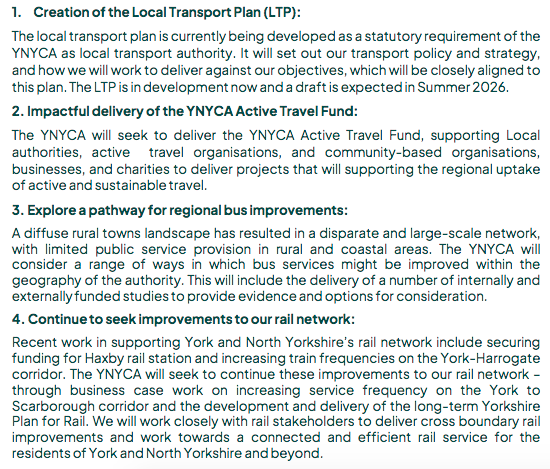
These are the Key Actions on transport identified by the Strategy.
Summary: a Disappointing Strategy
Anyone can make a lot of airy promises about outcomes, but without measurable targets and the actions to meet them those promises are meaningless.
On transport, the Strategy is a big step backwards compared to the Routemap to Carbon Negative: no specific, measurable goal for cycling and no specific measurable goal for reducing vehicle miles travelled.
What we have in the Strategy is what we usually get when targets prove challenging: remove the target instead of increasing efforts to meet it.
What is the biggest obstacle to building cycle routes in North Yorkshire? It is the recalcitrant North Yorkshire Council. How does the Strategy propose to overcome this obstacle? We don’t know, it doesn’t say.
Next Steps
The next steps are to incorporate feedback from the consultation, develop implementation plans, and establish governance, monitoring and reporting.