


Here are suggestions for the new Harrogate Town Council (HTC) as to how it can help improve Harrogate’s cycle network.
The town council’s influence is limited by the fact that North Yorkshire Council (NYC) is the highways authority; part of HTC’s role may be to request action from NYC, and to pressure NYC into timely delivery of ambitious schemes.
This post is structured as follows:
- Background to Cycle Network Planning in Harrogate
- What Can Harrogate Town Council Do? (Ideas for specific schemes that HTC could support)
- Mayor’s Active Travel Fund
- Rat-Running
- Offer – our willingness to help HTC develop a cycling strategy
1) Background to Cycle Network Planning in Harrogate
A) Local Cycling and Walking Infrastructure Plan (LCWIP)
NYC has a Harrogate & Knaresborough LCWIP from 2019.
The cycling element of it is a long report by consultants WSP, with a lot of general information. However, the consultants did identify four priority corridors for cycling improvements.

NYC had no interest in following up on the consultants’ suggestions. For six years, the LCWIP sat on a shelf gathering dust.
B) Cycle Network Map
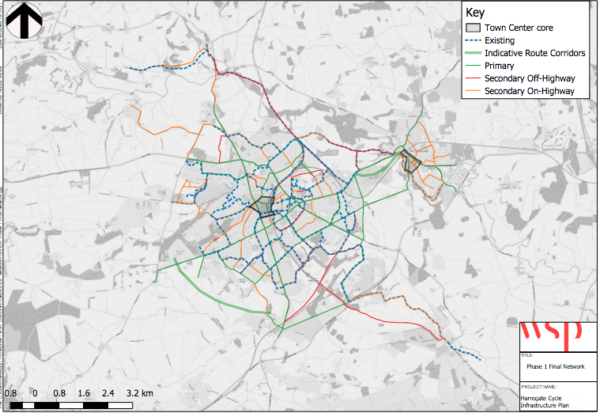
A cycle network map accompanied the LCWIP. (All NYC LCWIP documents can be found here).
It shows all the routes in Harrogate and Knaresborough which the council regards as potential cycle routes, and which should be improved to make them cycle-friendly.
The council provided no details about the improvements required, so we decided to do the work for them. We divided Harrogate into zones, and produced zone plans.
C) Zone Plans
Our Zone Plans contain proposals for all of the Harrogate cycle routes identified by the council’s cycle network map.
We cycled all the routes and took measurements (for example width of roads to see if on-highway cycle provision was possible).
We applied LTN 1/20 Cycle Infrastructure Design, which are national design standards, in coming up with our proposals.
We had a series of meetings with NYC Transport Planner Alex Kay to go through the proposals. This resulted in NYC’s Harrogate Cycle Network Prioritisation.
D) NYC’s Harrogate Cycle Network Prioritisation

NYC has produced a Cycle Network Prioritisation document.
Although this work began at our initiative, we have lost confidence in NYC’s handling of it. This is because the council is not genuinely committed to delivering the schemes they have prioritised.
The top priority was a coherent route Otley Road > Beech Grove > Victoria Avenue > Station Parade. These routes are still shown on NYC’s Harrogate Active Travel Projects map.
This has been NYC’s strategy since it won funding for an Otley Road cycleway in 2017.
Unfortunately the council abandoned Otley Road Phase 2 and Beech Grove despite majority support for going ahead, resulting in the yellow smudge on the priorities map.
This is symptomatic of NYC’s lack of commitment to building joined-up cycling routes.
That lack of commitment is a result of NYC’s exclusive focus on moving motor vehicles as its top priority.
2) What Can Harrogate Town Council Do?
The work of cycle network planning doesn’t need re-doing from scratch, and I suggest HTC should build on what has already been done.
HTC could make specific requests of NYC as the highways authority – projects that HTC would like NYC to prioritise.
It would make sense to start with the route that NYC is supposed to have provided over the last decade – Otley Road > Beech Grove > Victoria Avenue > Station Parade.
Improvements in other areas could make a big difference too.
Here are some specific suggestions.
A) Otley Road

NYC won funding for an Otley Road cycleway in 2017, but built only a fragment of it to poor standards in 2021.
The council still intends to build another section of it, ‘Phase 3’, as part of transport arrangements at the West Harrogate urban expansion.
Despite Active Travel England advising NYC that the design should be a footway and separate cycleway, the council is determined that it should be low-quality shared use. HTC could get involved here and ask for a better design, with separate cycling and walking facilities (1).
The other big problem is that NYC abandoned ‘Phase 2’ of the cycleway, which means that it doesn’t link to the key destination, the town centre. HTC could ask NYC to build Phase 2 (2).
B) Beech Grove

At the same time that it abandoned Phase 2 of Otley Road cycleway, NYC decided to remove the modal filters on Beech Grove.
The Beech Grove modal filters were successful. They made cycling MUCH safer, and provided a safe crossing of Beech Grove for people on foot.
They also prevented the use of this residential and park street as a through route for drivers. This made it much more pleasant.
Cutting out rat-running traffic fits in with the York & North Yorkshire Combined Authority’s Routemap to Carbon Negative for the region, which requires big increases in walking and cycling, and a reduction in motor vehicle trips.
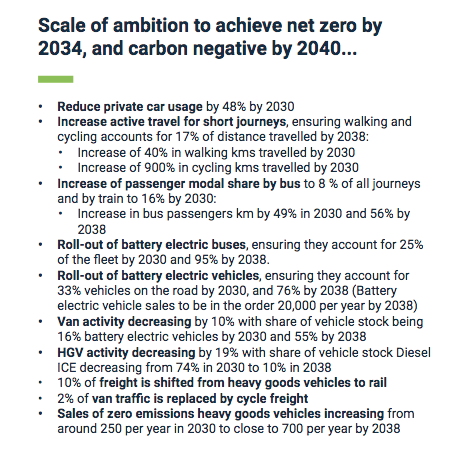
HTC could ask NYC to reinstate the Beech Grove modal filters (3).
This would be very effective, providing a safe cycle route into town for a large number of residents of south and west Harrogate.
It is also cheap. It just needs political will to stand up to any objectors, and stick with the scheme.
C) Beech Grove/Victoria Avenue Junction
There is a longstanding problem of drivers making an illegal movement straight on from Beech Grove to Victoria Avenue, putting pedestrians and cyclists at risk of physical harm.
NYC has moving traffic enforcement powers, which means it could put a camera at the junction and fine dangerous drivers.
HTC could ask NYC to put an enforcement camera at this junction (4).
D) Pedestrian and Cycle Crossing at the Junction of Otley Road and Beech Grove
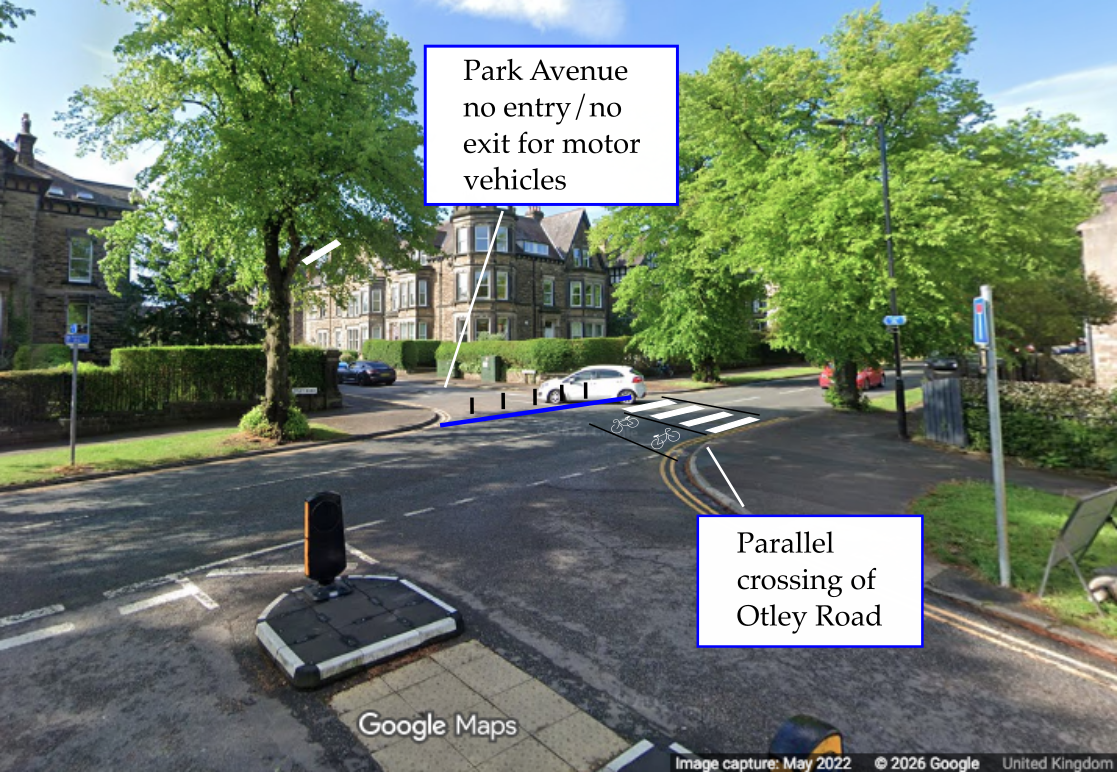
Another element that would improve the Beech Grove route into town is a crossing of Otley Road.
This would require the mouth of Park Avenue to be filtered, so motor vehicles could not turn into or out of it from/to Otley Road. Inconvenience to drivers would be minimal, as there are plenty of other roads from Otley Road to the West Park area.
A London council has built a similar design.
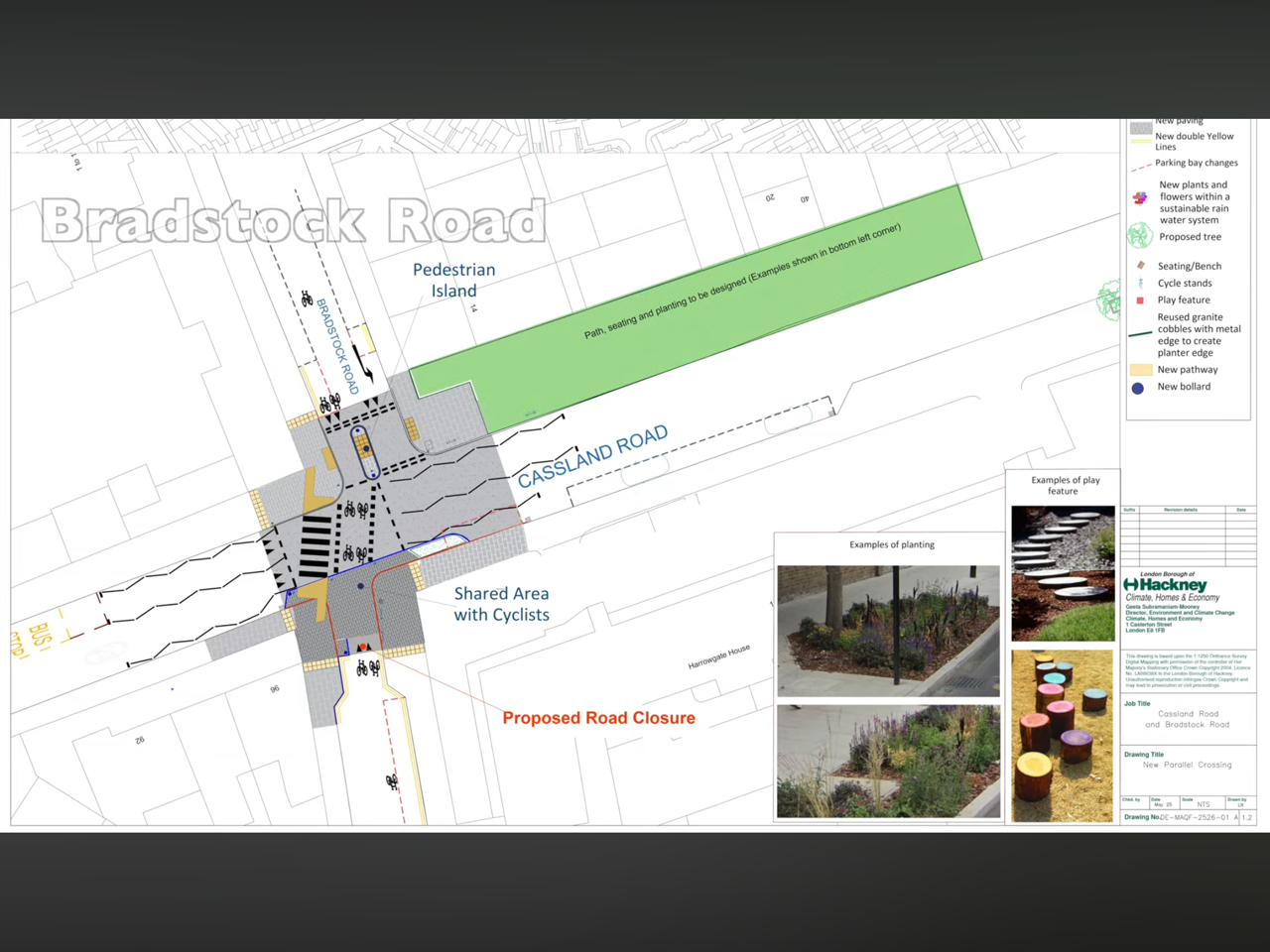
HTC could ask NYC to design and build a parallel crossing of Otley Road (5).
E) Pedestrian Crossings at the Prince of Wales Roundabout

This is a walking scheme rather than cycling.
Crossing the arms of the Prince of Wales roundabout on foot requires people to brave two lanes of traffic at a time with no priority, which is dangerous. Formal crossings are needed.
There are proposals for crossings in the latest Harrogate Transport Improvement Programme report.

It should not be assumed that NYC will build them – it will need pressure over a long period of time. HTC could ask NYC to build crossings at the Prince of Wales roundabout as a priority (6).
F) Oatlands Drive
Oatlands Drive needs cycle infrastructure to enable pupils to cycle to school at St Aidan’s and St John Fisher.
NYC says it is going to make Oatlands Drive 20mph with traffic calming, but this will not be enough to make it safe for cycling.

In Feburary 2023, consultants commissioned by NYC told the council how to make Oatlands Drive safe for cycling, but NYC shelved the report and nothing has happened.
HTC could ask NYC to design, fund and build cycling infrastructure on Oatlands Drive (7).
G) Bilton to Hornbeam Park
NYC has belatedly started work on one of the LCWIP routes, Bilton to Hornbeam Park.
Experience shows there is a risk of delay > delay > delay > dilute > abandon.
HTC could ask to be briefed on the work, then ensure that the designs are ambitious and delivered in a timely fashion (8).
H) Harrogate Station Gateway
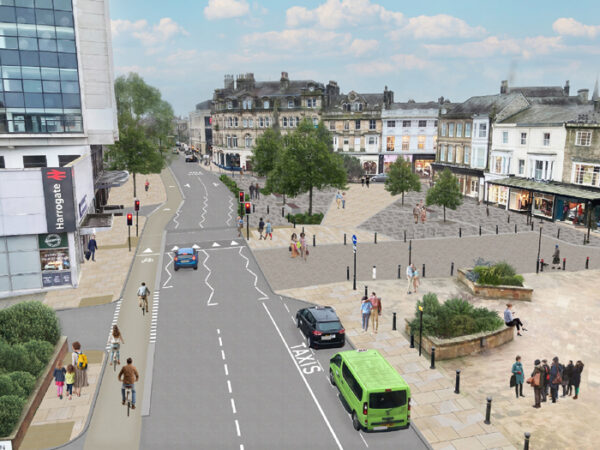
Six years after the Harrogate Station Gateway project started, nothing has been built.
NYC says it is going to start building soon, and there is to be a one-way cycle track on part of Station Parade.
As things stand, the cycle track will not join up to any other facilities, notably planned cycle facilities on Victoria Avenue.
We have made suggestions as to how the cycle track could link to other cycle routes. HTC could follow up with NYC to make sure the Station Gateway cycle track is not isolated and useless (9).
I) A59 Skipton Road
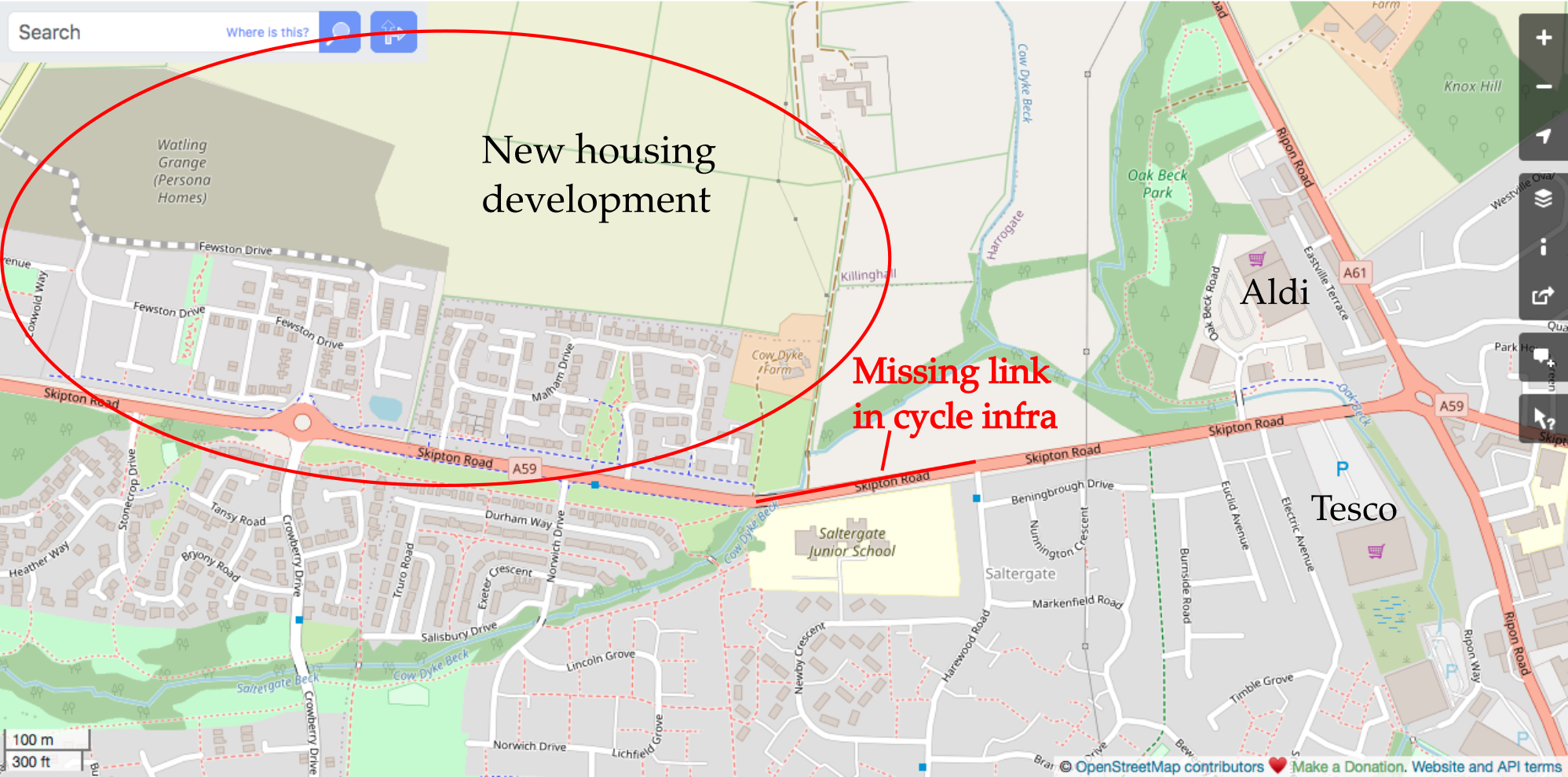
A new Tesco has just opened on the A59 Skipton Road, and a vast housing development is still being built out a little further along the road.
Unfortunately there is no cycle link between the supermarket and the houses. The small amount of cycle infrastructure associated with Tesco is poor quality.
HTC could ask NYC Highways Development Control (i) to apply the standards in LTN 1/20 Cycle Infrastructure Design to cycle facilities associated with development and (ii) to build a cycle link between the houses and the shops on the A59 Skipton Road (10).
J) Harrogate Transport Improvement Programme (HTIP)

The Harrogate Transport Improvement Programme (HTIP) was NYC’s response to the 2019 Congestion Survey, in which 77% of 15,500 respondents said they wanted better walking and cycling facilities.
Since 2019, NYC has wasted six years and spent £459,186 on consultants but delivered no on-the-ground improvements.
Recently, the council published a very brief summary of their consultants’ second HTIP report, from which it is clear that walking and cycling have been sidelined. HTIP is now about motor vehicles; there are also proposals for Park & Ride and bus lanes, which NYC will probably never implement.

I have made suggestions for projects that would refocus HTIP on walking and cycling, as originally intended, in the A61 Leeds Road corridor.
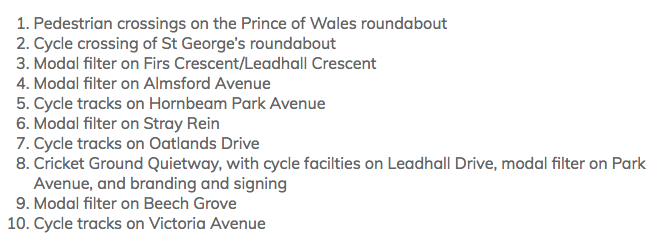
HTC could ask NYC to refocus HTIP on walking and cycling projects in the A61 Leeds Road corridor (11).
K) A59 Knaresborough Road

There is a longstanding wish for a cycle link between Knaresborough and Harrogate.
The council did a design for the section of the A59 from Forest Lane to the Empress roundabout in 2016, but nothing was done with it.
Knaresborough Road is still on NYC’s cycling priorities list.


NYC is currently trying to design a cycle path at the High Bridge Knaresborough end of the route, but appears to be on the verge of abandoning the scheme. This missing link is important.
HTC could ensure that NYC builds a joined-up cycle route on the A59 Knaresborough Road to proper standards in a reasonable timeframe (12).
L) Sainsbury’s Junction of A661 Wetherby Road
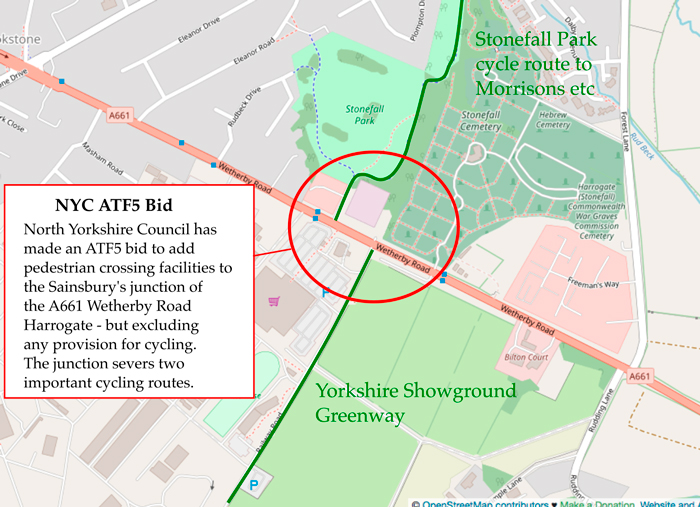
In 2025, NYC announced a revamp of the Sainsbury’s junction of the A661 Wetherby Road.
The junction severs an important cycle route, but the council has excluded cycling from its plans.
Active Travel England has identified multiple Critical Safety Issues with NYC’s junction design.
HTC could ensure that NYC’s junction revamp caters for all legitimate road users, including people on bikes (13).
M) Nidderdale Greenway and Harland Way
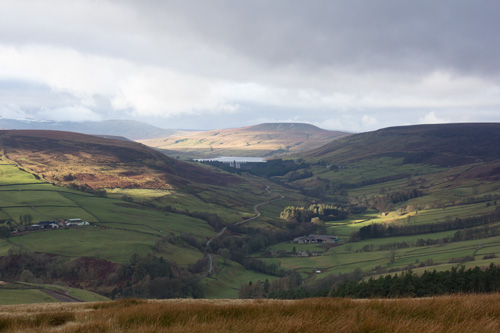
There is a longstanding wish to extend the Nidderdale Greenway from Ripley to Pateley Bridge, and beyond to Scarhouse Reservoir.
We also want to see a new cycle route developed between Harrogate and Spofforth, to link to the Harland Way.
HTC could support and help with these projects, which would be fantastic for locals and visitors to Harrogate (14).
3) Mayor’s Active Travel Fund

The Mayor’s Active Travel Fund opens to bids in February 2026.
HTC could make a bid to the Mayor’s Active Travel Fund (15).
The bid could be for cycle parking, resurfacing of a greenway, or some other active travel project.
We can provide suggestions if HTC wishes.
4) Rat-Running
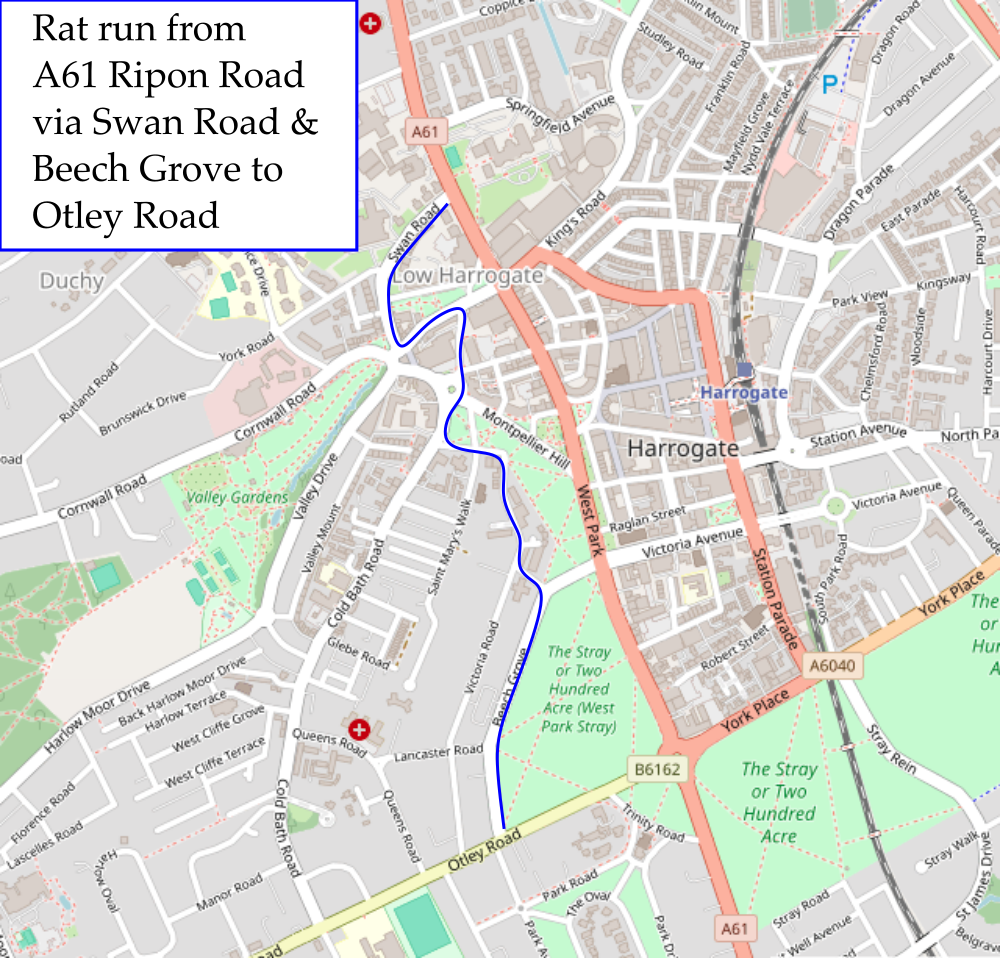
There is an increasing problem of rat-running in Harrogate – the use by drivers of residential streets as through routes.
The more through traffic there is on residential streets, the less attractive they are for walking and cycling.
As more houses are built, the problem is likely to get worse unless something is done.
Modal filters are the solution: people can still drive to and from their houses, but through traffic is removed from the streets.
One rat-run is from the A61 Ripon Road to Otley Road (see image above).
Another is the use of the Mallinson estate as a cut-through from Leeds Road to Leadhall Drive, with a further rat run the other side of the A61 Leeds Road at M&S.

If traffic is allowed to continue to rat run along residential streets, the quality of life on those streets will be degraded, and people will be deterred from walking and – especially – cycling.
HTC could agree that as a matter of principle through traffic should stay on the main roads, which are designed for high volumes of motor vehicles. It could work with NYC to stop up rat runs (16).
5) Offer
We are happy to discuss these ideas with HTC, and/or to cycle areas of Harrogate with Councillors to discuss problems and solutions.
Excellent suggestions as usual David. It strikes me that it really doesn’t require the moving of heaven and earth to connect our existing cycle infrastructure and at least provide the bare bones of a cycle network so it baffles me why NYC drag their feet. A lot could be achieved by using LTNs, school streets and 20mph zones. Hopefully the town council can champion active travel as a priority.
Perhaps roads such as Coach Road and the roads which connect it to Regent Parade, and Stray Rein which seem to serve no purpose other than allowing rat running and parking could be shut to traffic and used as cycle paths. This would also allow some road space to be returned to stray land which might allow improvements to existing stray paths to be made whilst appeasing the stray protection brigade.
Thanks for reading and commenting, I appreciate it.
I agree about Regent Parade – even allowing contraflow cycling against the one-way system would be a start.
The council is very focused on moving motor vehicles and very conservative. We need them to get over their opposition to modal filters if we are to make residential streets less car-dominated and safer for walking and cycling.