

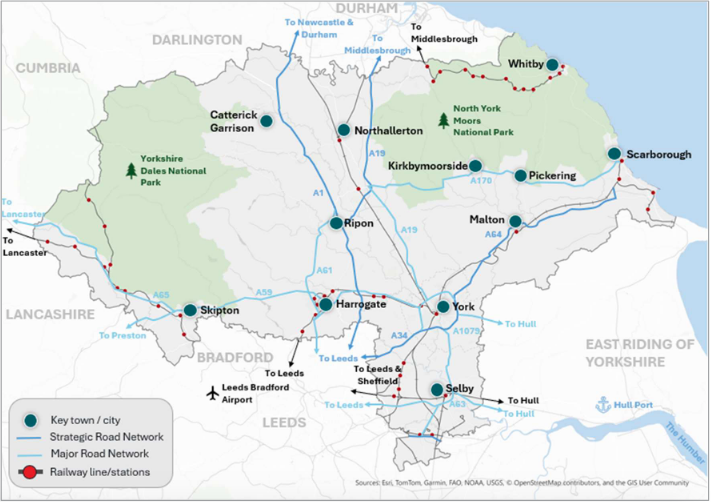
A consultation on the Mayor’s Local Transport Plan (LTP) opened on 26th August 2026.
Mayor David Skaith describes the LTP as ‘a rallying cry for change’. He wants ‘safe and attractive walking, wheeling and cycling routes that, amongst other things, enable children to travel to school safely and independently.
This post is organised as follows:
Brief Summary of the LTP
This is the full LTP. This is my long summary from June this year.
What follows here is a very brief summary of the LTP’s eight sections.
1) Introduction
The Introduction says that it is the Mayor who is responsible for the LTP rather than, as previously, the two councils (City of York Council and North Yorkshire Council).
2) Unlocking York & North Yorkshire’s Potential
The Unlocking York & North Yorkshire’s Potential chapter of the LTP says that local transport should improve access to opportunity, cut greenhouse gas emissions (where transport is 32% of the total), and support healthier lives.
It notes that the region plans 60,000 new homes over 10 years, and has ambitious plans for economic growth. Transport should be a strategic enabler of inclusive growth.
‘Transport investment must help create healthy and resilient communities, connect people to opportunity, support affordable and well-located homes, enable sustainable economic growth and protect the region’s environment’.
Cleaner and greener transport is one of the Mayor’s priorities.
3) 2050 Vision for a Connected City Region Rural Powerhouse
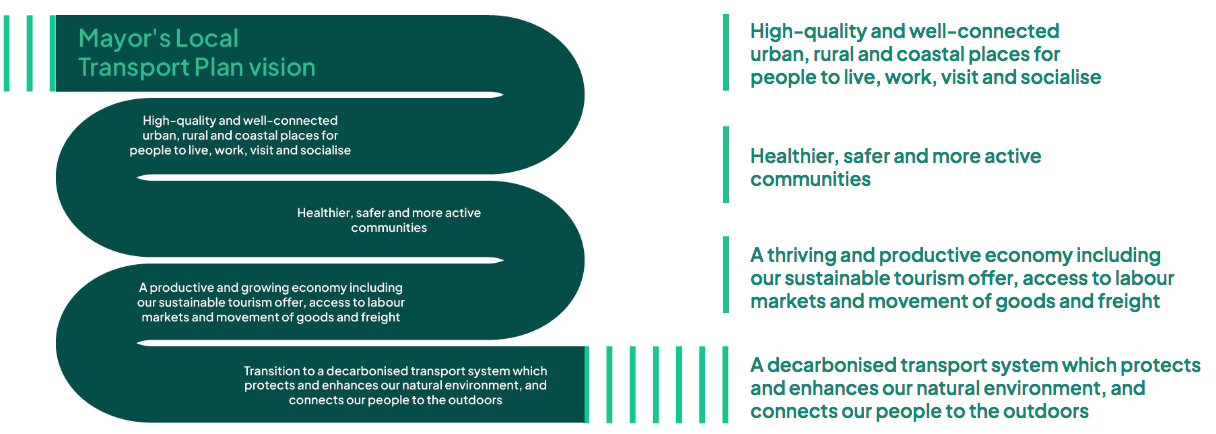
The four elements of the Mayor’s LTP Vision support cycling, notably with healthier and more active communities and a decarbonised transport system.
Each strand of the Vision has Critical Outcomes attached to it, and making more short trips by walking, wheeling and cycling recurs in the Critical Outcomes.
The Mayor’s targets are:
- 40% of trips by walking, wheeling and cycling by 2050 and
- 10% of trips by public transport by 2050
‘…We need to reduce dependence on cars and make walking, wheeling and cycling the easiest and most attractive choices for everyday journeys and leisure…The benefits are significant. More walking, wheeling and cycling means healthier people, cleaner air and stronger communities…But people need to feel safe to travel actively. Concerns about road safety are a major barrier…Addressing these issues will require safer streets, lower traffic speeds, better crossings, improved lighting and more welcoming public spaces’.
4) Connected Places
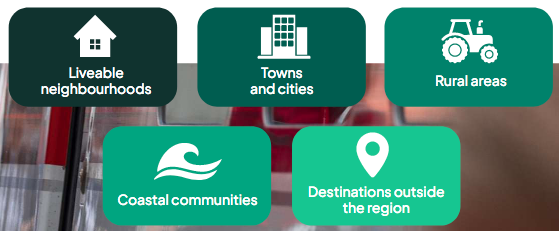
The Connected Places chapter identifies five place types and their specific transport challenges. The place types are:
- Liveable Neighbourhoods
- Towns and Cities
- Rural Areas
- Coastal Communities and
- Destinations Outside the Region
In Liveable Neighbourhoods (residential areas), the Mayor wants to limit the negative impact of through traffic and prioritise walking, wheeling and cycling. This is to include Low-Traffic Neighbourhoods.
The Towns and Cities section says that urban areas need to grow without significantly increasing traffic levels. That means investing in coherent, safe and high-quality walking, wheeling and cycling networks in towns and cities.
5) Network Principles
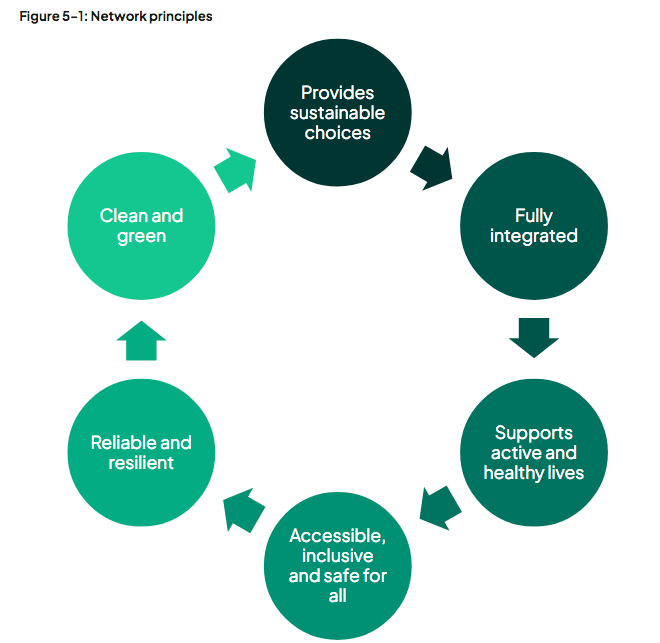
The Network Principles chapter identifies six elements:
- provides sustainable choices
- fully integrated
- supports active and healthy lives
- accessible, inclusive and safe for all
- reliable and resilient and
- clean and green
The LTP makes clear that high-quality walking, wheeling and cycling networks, including to bus and rail stations, are key parts of the network.
The Mayor is to write and publish a detailed Walking, Wheeling and Cycling Strategy, which will include a Strategic Cycle Network for the region.
He also commits to using new powers against illegal pavement parking.
The LTP’s solution to the negative environmental effects of car-based transport is Avoid (reduce the need for travel), Shift (to the lowest-carbon form of travel), Improve (reduce vehicle emissions).
6) Integrated Modes
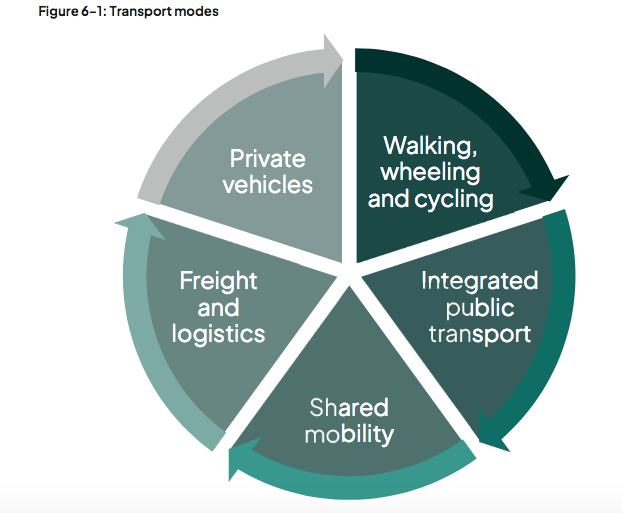
This chapter sets a goal for modal shift to sustainable modes.
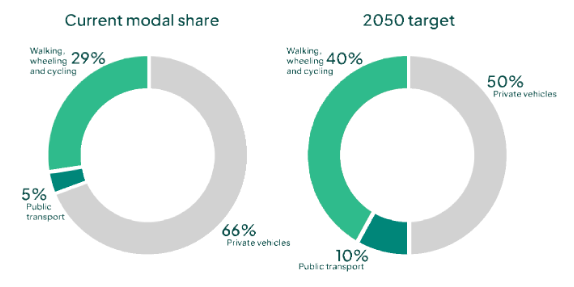
Walking, wheeling and cycling are to increase from 29% now to 40% in 2050.
There is also a target of 65% of trips under 3 miles by walking, wheeling and cycling.
‘…we need to establish a connected high-quality network of routes and enable journeys made by active modes to be as frictionless as possible, allowing walking, wheeling and cycling to become the default choice for all short journeys in York and North Yorkshire.
In our urban areas, we need to fill short gaps in local walking, wheeling and cycling network to enable people to undertake day-to-day activities more easily by active modes.
We need to provide adequate walking, wheeling and cycling routes to bus stops and railway stations to ensure that more people can access our public transport network sustainably’.
The Mayor also commits to side road zebras, and the LTP mentions Quiet Lanes in rural areas.
This chapter mentions Park & Ride for ‘our larger towns and cities’.
The LTP has these comments about private vehicles:
‘As the region grows, we need to ensure that population growth is not accompanied by significant traffic growth which will excerbate the negative impacts of traffic on everyone’s lives.
Unconstrained car growth will not make efficient use of our limited road capacity, so we need to design our places around the needs of people, not traffic, and we need to think about where and how we invite private vehicles into our local neighbourhoods, towns and cities’.
The LTP suggests measures to combat car dominance including re-purposing on-street car parking and stopping rat-running through local neighbourhoods.
There’s a hierarchy for streets in towns and cities.
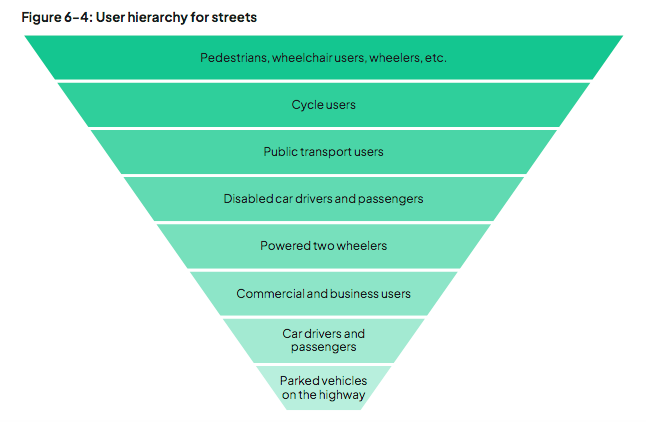
‘On local residential streets, we will want to give much more priority and focus o the needs of those who are walking, wheeling and cycling, which may mean limiting where we allow cars and other motorised vehicles’.
The Mayor will consider developing a ‘movement and place’ plan for the region.
7) Measures for Success
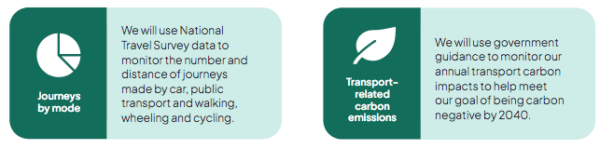
The main Measures for Success that will be used by the Mayor are:
- Key Performance Indicators
- more detailed metrics in a Monitoring and Evaluation Plan and
- the DfT’s Local Transport Outcome Framework
8) Delivering the Strategy
There is to be a pipeline of schemes that will implement the vision and objectives of the LTP.
The Mayoral Combined Authority does not yet have a transport assurance framework, but will develop one. The LTP sets out which reports will be made and when.
York & North Yorkshire CA is now an Established Mayoral Strategic Authority, which means it has a single integrated funding settlement, and greater control over how it spends its money.
It is the highways authorities (York and North Yorkshire) as well as the National Park Authorities that will have to do most of the delivery.
There will be a Local Transport Delivery Plan soon, and the CA will carry out multi-modal transport corridor studies.
Assessment of the LTP and Suggested Comments
The LTP is excellent.
It contains nearly everything we would wish to see, including an emphasis on sustainable transport and liveable neighbourhoods, measurable targets for modal shift to active travel, and acknowledgement of the disbenefits when motor vehicles dominate the spaces where we live, work and shop.
These are some suggested comments or improvements:
- it will be up to North Yorkshire Council Highways to actually deliver on the LTP. Will they do any of it? There is no indication that they have budged from their de facto position that nothing matters except motor vehicles
- although there is a measurable target for modal shift to walking, wheeling and cycling, there is no cycling-specific target, which raises fears that cycling may miss out again
- there was a target to reduce vehicle miles travelled in the Routemap to Carbon Negative, but there is now no target – just the idea that population growth should not mean traffic growth. That is a step backwards
- the timings of pedestrian and cycle crossings are not mentioned. This is one significant way in which North Yorkshire Council prioritises motor vehicles; it would be good if the CA could include a specific policy in the LTP
How to Respond
There is a link to the survey on the CA’s consultation page.